Advertisements
Advertisements
प्रश्न
Give reason, why a matured mammalian erythrocyte lacks nucleus and mitochondria?
Advertisements
उत्तर
A matured mammalian erythrocyte lacks a nucleus and mitochondria. The lack of a nucleus
increases the surface area-volume ratio of RBCs, thus increasing the area for oxygen absorption.
Also, the lack of a nucleus reduces the size of the cell, making it easy to flow through the blood
vessels and more cells can be accommodated in a small area.
The lack of mitochondria implies that the cell does not use any oxygen absorbed for respiration,
thus increasing the efficiency of the cell to transport oxygen as all the oxygen absorbed is
transported without any loss.
संबंधित प्रश्न
Heart sounds are produced due to ______.
-
closure of tricuspid and bicuspid valves
-
rushing of blood through valves producing turbulence
-
closure of atrioventricular and semilunar valves
-
entry of blood into auricles
Name the following:
The valve present in between the chambers on the right side of the human heart.
Differentiate between members of the following pairs with reference to the aspect asked
within bracket:
Erythrocytes and leucocytes (function)
what is Venule?
How do you account for the following difference?
The walls of the right ventricle are thicker than those of the right auricle.
Production of RBCs occurs in ______.
Label the diagram given below to show the four main parts of the urinary system and answer the following questions.

- Which organ removes extra salts and water from the blood?
- Where is the urine stored?
- What is the tube through which urine is excreted out of the body?
- What are the tubes that transfer urine from the kidneys to the urinary bladder called?
______ prevent blood clotting.
From the following identify the normal haemoglobin count in adult male.
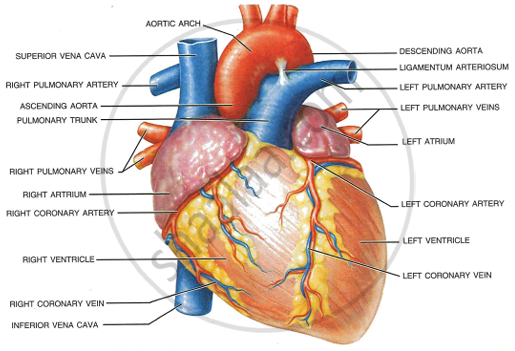 |
Can you answer why the pulmonary artery shown in Fig. is blue in colour?
