Advertisements
Advertisements
Question
Gender of child is determined by the male partner of couple. Explain with reasons whether this statement is true or false.
Advertisements
Solution
The statement “Gender of the child is determined by the male partner of the couple” is true.
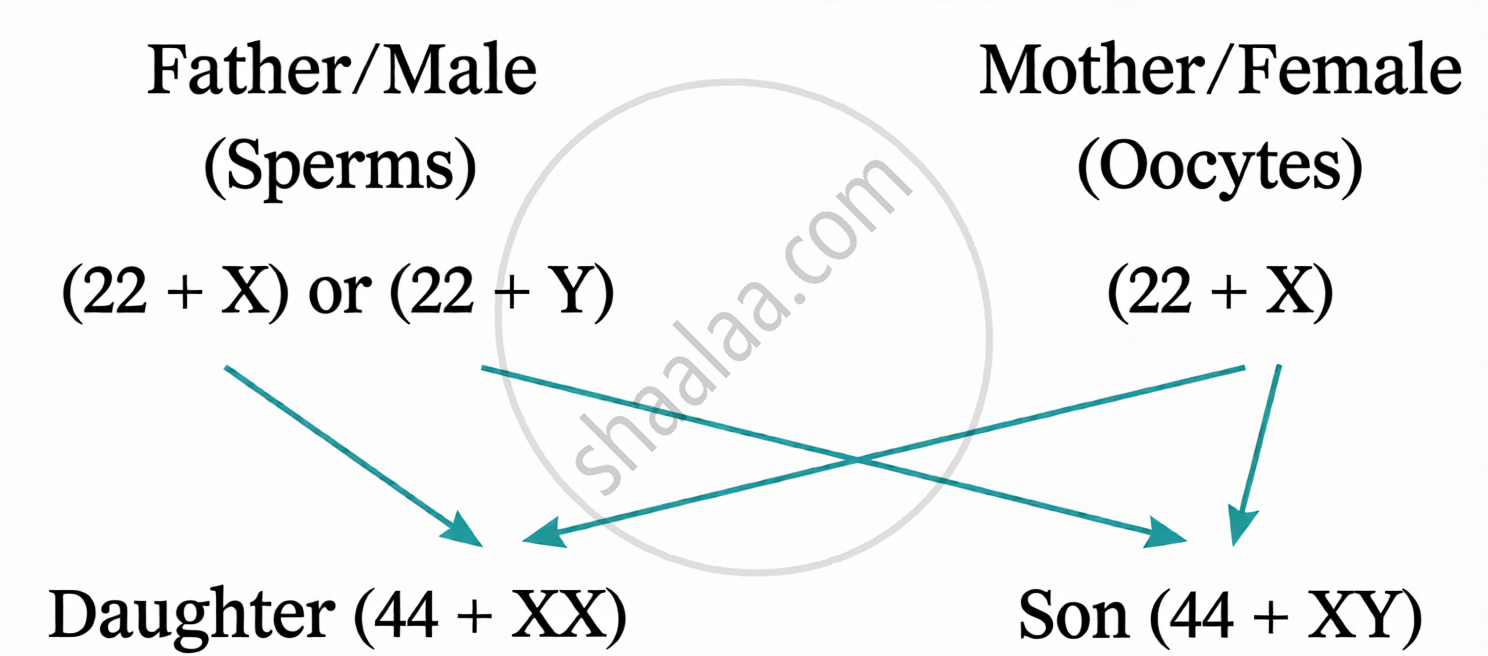
- In males, two types of sperm are produced. One type carries an X chromosome, and the other carries a Y chromosome, along with autosomes. In females, all ova carry only the X chromosome. Therefore, the sperm that fertilizes the ovum determines the sex of the child.
- If an X-bearing sperm fertilizes the ovum, an XX zygote is formed and a female child (daughter) is born. If a Y-bearing sperm fertilizes the ovum, an XY zygote is formed and a male child (son) is born.
- Thus, the father or male partner determines the sex of the child because he contributes either an X or a Y chromosome.
APPEARS IN
RELATED QUESTIONS
Which part of the human body produces sperms?
What do the testes in a man produce?
What are the male gonads in human beings?
What is the name of the narrow opening between the uterus and the vagina.
What changes are seen in boys at the time of puberty?
Which among the following are not the functions of testes at puberty?
(i) formation of germ cells
(ii) secretion of testosterone
(iii) development of the placenta
(iv) secretion of estrogen
X and Y are two human beings. The organ A in the reproductive system of X releases a mature gamete B once a month which goes into a tube-like structure C through a funnel-like opening. The organ D in the reproductive system of Y makes and releases gametes E which pass through a duct F and are introduced by an organ of Y, into the body of X. B and E fuse together in C to form a new cell G. The cell G divides repeatedly to form a ball of cells H which gets embedded in the lining of organ I of reproductive system of X where it grows and develops into a baby.
(a) Name (i) organ A, and (ii) gamete B.
(b) Write two names of tube-like structure C.
(c) Name (i) organ D, and (ii) gamete E.
(d) Write two names of duct F.
(e) Name (i) cell G (ii) ball of cells H, and (iii) organ I.
(f) Out of X and Y, which one is (i) male, and (ii) female?
Write two examples of sexually transmitted diseases caused by virus.
Write two examples of sexually transmitted diseases caused by bacteria.
Describe in brief the role of vas deferens in human male reproductive system.
Describe the role of the following in human beings:
(i) Seminal vesicles
(ii) Prostate gland
Name the following:
Two accessory glands in the male reproductive system.
Define the following:
Implantation
Name the Following
What does this abbreviation stand for IUD?
Choose the Odd One Out:
Choose the Odd One Out:
Match Columns I and II and select the correct option.
| Columns I | Columns II | ||
| i. | Transfer of sperms in the female genital tract. | a. | Gestation |
| ii. | Delivery of baby | b. | Fertilization |
| iii. | Fusion of male and female gamete. | c. | Parturition |
| iv. | Formation of sperms and ovum | d. | Insemination |
| e. | Gametogenesis |
Which of the following is an example of a secondary sexual characteristic in humans?
