Gender of child is determined by the male partner of couple. Explain with reasons whether this statement is true or false.
Advertisements
प्रश्न
Gender of child is determined by the male partner of couple. Explain with reasons whether this statement is true or false.
Advertisements
उत्तर
The statement “Gender of the child is determined by the male partner of the couple” is true.
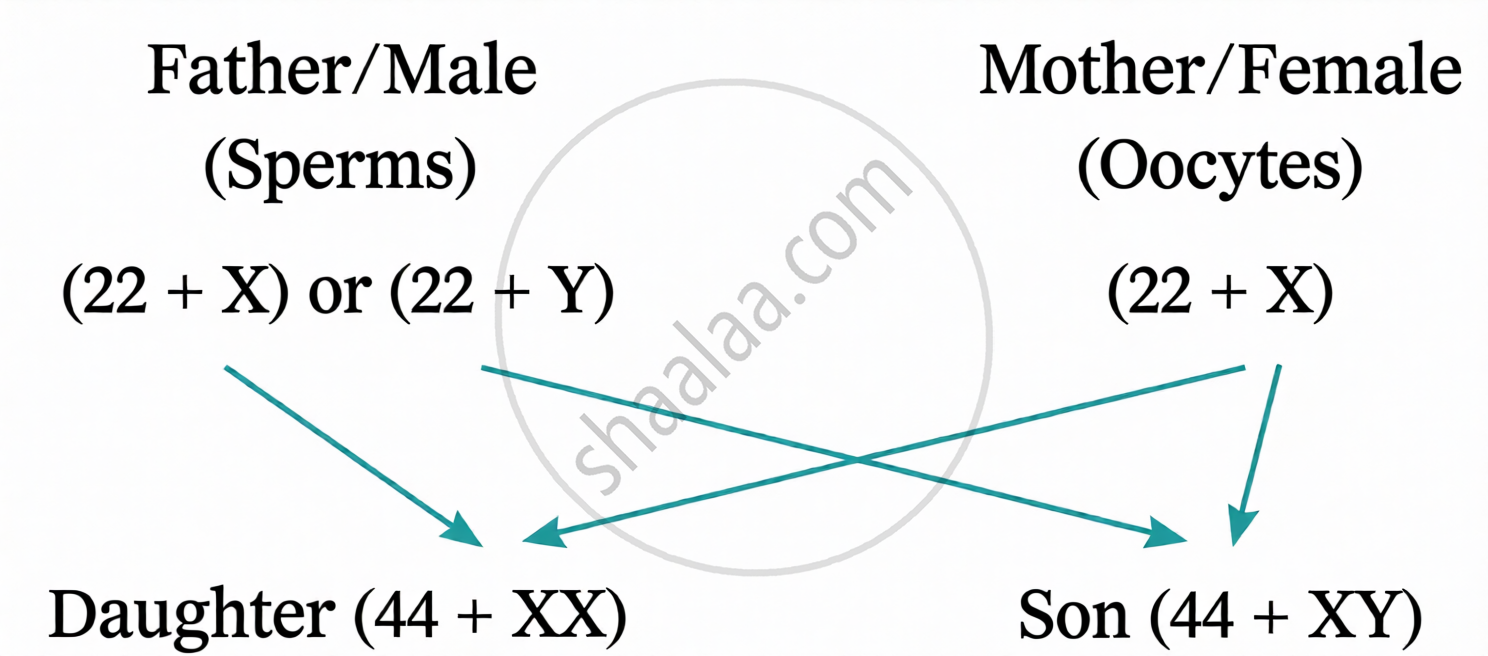
- In males, two types of sperm are produced. One type carries an X chromosome, and the other carries a Y chromosome, along with autosomes. In females, all ova carry only the X chromosome. Therefore, the sperm that fertilizes the ovum determines the sex of the child.
- If an X-bearing sperm fertilizes the ovum, an XX zygote is formed and a female child (daughter) is born. If a Y-bearing sperm fertilizes the ovum, an XY zygote is formed and a male child (son) is born.
- Thus, the father or male partner determines the sex of the child because he contributes either an X or a Y chromosome.
APPEARS IN
संबंधित प्रश्न
Name the human male reproductive organ that produces sperms and also secretes a hormone. Write the functions of the secreted hormone.
Describe the function of placenta.
What are the functions of testes in the human male reproductive system?
List two example of each diseases caused due to (i) bacterial infection and (ii) viral infection. Which device or devices may be used to prevent the spread of such diseases.
State the changes that take place in the uterus when Implantation of embryo has occurred
Give scientific reasons: Mature erythrocytes in humans lack nucleus and mitochondria
The structure formed by the villi of the embryo and the uterus of the mother.
Give a biological explanation for the following.
The placenta is an important structure for the development of a foetus.
Where in the human body does an ovum get fertilised?
X and Y are two human beings. The organ A in the reproductive system of X releases a mature gamete B once a month which goes into a tube-like structure C through a funnel-like opening. The organ D in the reproductive system of Y makes and releases gametes E which pass through a duct F and are introduced by an organ of Y, into the body of X. B and E fuse together in C to form a new cell G. The cell G divides repeatedly to form a ball of cells H which gets embedded in the lining of organ I of reproductive system of X where it grows and develops into a baby.
(a) Name (i) organ A, and (ii) gamete B.
(b) Write two names of tube-like structure C.
(c) Name (i) organ D, and (ii) gamete E.
(d) Write two names of duct F.
(e) Name (i) cell G (ii) ball of cells H, and (iii) organ I.
(f) Out of X and Y, which one is (i) male, and (ii) female?
When a female child is born, her ovaries already contain thousands of immature eggs (or ova) contained in immature structures A. On maturing, A bursts open and an egg shoots out of the ovary in a process called B. The process B starts in the females at puberty and occurs again and again after a time period x. Before every occurrence of process B, the inner lining of uterus becomes thick and soft with lots of blood vessels in it. When the egg cell gets fertilised by a sperm, then an event C occurs in the life of mature human female which lasts for time period y leading to the birth of baby. If, however, the egg cell released by the ovary does not get a sperm to fuse with, then the thick and soft inner lining of uterus breaks down and comes out of the female's body in an event called D. The occurrence of event D is controlled by chemical substances E.
(a) What are A?
(b) What is process B?
(c) What is the time period x?
(d) Name the event C.
(e) How much is the time period y?
(f) What is the name of process D?
(g) Name the chemical substances E.
The germ cell A produced by a person X is round in shape and it fuses with another germ cell B having a long tail and produced by a person Y. The fusion of A and B produces a new cell C. The cell C divides repeatedly and grows inside the organ D of person X to form E in which the body features of the unborn baby are not much developed. E grows further to form F in which the various body features of the unborn baby (like hands, legs, head, eyes, and ears, etc.) can be identified. F grows further and ultimately forms a baby. What are A, B, C, D, E and F? Out of the two persons X and Y, which one is male and which one female?
In humans, the fertilization takes place in:
Trace the path of sperms from where they are produced in human body to the exterior.
Give the names:
Methods of family planning.
Sketch and label human female reproductive system.
Is the woman responsible for sex-determination of child? Justify your answer.
Explain the term Parturition or birth.
Name the Following
What does this abbreviation stand for LH?
Choose the Odd One Out:
Mention the importance of the position of the testes in humans.
