Advertisements
Advertisements
Question
From a solid cylinder whose height is 2.4 cm and diameter 1.4 cm, a conical cavity of the same height and same diameter is hollowed out. Find the total surface area of the remaining solid to the nearest cm2
[use `pi = 22/7`]
Advertisements
Solution
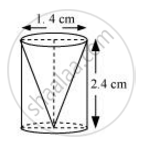
Given that,
Height (h) of the conical part = Height (h) of the cylindrical part = 2.4 cm
Diameter of the cylindrical part = 1.4 cm
Therefore, radius (r) of the cylindrical part = 0.7 cm
Slant height (l) of conical part =` sqrt(r^2 + h^2)`
`= sqrt((0.7)^2+(2.4)^2) `
`=sqrt(0.49+5.76)`
`=sqrt(6.25)`
= 2.5
Total surface area of the remaining solid will be = CSA of cylindrical part + CSA of conical part + Area of cylindrical base
= 2πrh + πrl + πr2
`= 2xx 22/7xx 0.7xx2.4+22/7xx0.7xx2.5+22/7xx0.7xx0.7`
= `4.4 xx 2.4 + 2.2 xx 2.5 + 2.2 xx 0.7`
= 10.56 + 5.50 +1.54
= 17.60 cm2
The total surface area of the remaining solid to the nearest cm2 is 18 cm2.
APPEARS IN
RELATED QUESTIONS
504 cones, each of diameter 3.5 cm and height 3 cm, are melted and recast into a metallic sphere. Find the diameter of the sphere and hence find its surface area.
[Use π=22/7]
A wooden article was made by scooping out a hemisphere from each end of a solid cylinder, as shown in given figure. If the height of the cylinder is 10 cm, and its base is of radius 3.5 cm, find the total surface area of the article.
[Use `pi = 22/7`]

Water in a canal, 5·4 m wide and 1·8 m deep, is flowing with a speed of 25 km/hour. How much area can it irrigate in 40 minutes, if 10 cm of standing water is required for irrigation?
A tent consists of a frustum of a cone capped by a cone. If the radii of the ends of the frustum be 13 m and 7 m , the height of the frustum be 8 m and the slant height of the conical cap be 12 m, find the canvas required for the tent. (Take : π = 22/7)
Radii of circular ends of a solid frustum off a cone re 33cm and 27cm and its slant height are 10cm. find its total surface area?
In Figure 4, from a rectangular region ABCD with AB = 20 cm, a right triangle AED with AE = 9 cm and DE = 12 cm, is cut off. On the other end, taking BC as diameter, a semicircle is added on outside the region. Find the area of the shaded region.\[[Use\pi = 3 . 14]\]

In Fig. 6, OABC is a square of side 7 cm. If OAPC is a quadrant of a circle with centre O, then find the area of the shaded region. `[\text\ User=22/7]`

Two cubes each of volume 27 cm3 are joined end to end to form a solid. Find the surface area of the resulting cuboid.
The inner and outer radii of a hollow cylinder are 15 cm and 20 cm, respectively. The cylinder is melted and recast into a solid cylinder of the same height. Find the radius of the base of new cylinder.
A solid is in the form of a cylinder with hemispherical ends. Total height of the solid is 19 cm and the diameter of the cylinder is 7 cm. Find the volume and total surface area of the solid.
Volume and surface area of a solid hemisphere are numerically equal. What is the diameter of hemisphere?
If the total surface area of a solid hemisphere is 462 cm2, then find its volume.
From a cubical piece of wood of side 21 cm, a hemisphere is carved out in such a way that the diameter of the hemisphere is equal to the side of the cubical piece. Find the surface area and volume of the remaining piece.
A right triangle whose sides are 15 cm and 20 cm (other than hypotenuse), is made to revolve about its hypotenuse. Find the volume and surface area of the double cone so formed. (Choose value of π as found appropriate)
The volume of a hemisphere is 19404 cm3. The total surface area of the hemisphere is
If the surface areas of two spheres are in ratio 16 : 9, then their volumes will be in the ratio ______.
The radius of spherical balloon increases from 8 cm to 12 cm. The ratio of the surface areas of balloon in two cases is ______.
If two solid hemispheres of the same base radius r are joined together along their bases, then curved surface area of this new solid is ______.
The total surface area of a solid hemisphere of radius 7 cm is ______.
There are two identical solid cubical boxes of side 7 cm. From the top face of the first cube a hemisphere of diameter equal to the side of the cube is scooped out. This hemisphere is inverted and placed on the top of the second cube’s surface to form a dome. Find
- the ratio of the total surface area of the two new solids formed
- volume of each new solid formed.
