English

Find the Value of X, If Tan Sec − 1 ( 1 X ) = Sin ( Tan − 1 2 ) , X > 0 . - Mathematics

Advertisements
Advertisements

Question

Find the value of x, if tan `[sec^(-1) (1/x) ] = sin ( tan^(-1) 2) , x > 0 `.

Sum
Advertisements

Solution

Let sec-1 `(1/x) = theta`

` ⇒ sec theta = 1/x`

⇒ cos θ = x 

⇒ tan ` (sec^(-1) (1/x)) = tan theta = sqrt(1 -x^2 ) /x `                ...(1) 
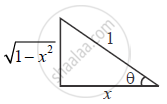
Now consider, 

sin ( tan -1 2 )

Let tan-1 2 = Φ

 tan Φ = 2 

sin ( tan-1 2) = sin Φ = `2/sqrt(5) `            ...(ii) 
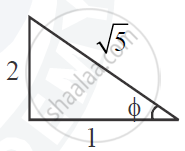
From (i) and (ii)

`sqrt(1- x^2 )/x = 2/sqrt(5)`

5(1 - x) = 4x

`x = +- sqrt(5)/3 " but " x > 0 ⇒ x = sqrt(5)/3`

shaalaa.com
  Is there an error in this question or solution?
2018-2019 (March) 65/3/3

RELATED QUESTIONS

Solve for x:

`2tan^(-1)(cosx)=tan^(-1)(2"cosec" x)`


Prove that

`tan^(-1) [(sqrt(1+x)-sqrt(1-x))/(sqrt(1+x)+sqrt(1-x))]=pi/4-1/2 cos^(-1)x,-1/sqrt2<=x<=1`


Evaluate the following:

`cos^-1{cos  ((4pi)/3)}`


Evaluate the following:

`cos^-1(cos4)`


Evaluate the following:

`tan^-1(tan12)`


Write the following in the simplest form:

`sin{2tan^-1sqrt((1-x)/(1+x))}`


Evaluate:

`sec{cot^-1(-5/12)}`


`sin^-1x=pi/6+cos^-1x`


Prove the following result:

`tan^-1  1/7+tan^-1  1/13=tan^-1  2/9`


Prove the following result:

`tan^-1  1/4+tan^-1  2/9=sin^-1  1/sqrt5`


Solve the following equation for x:

tan−1(x + 2) + tan−1(x − 2) = tan−1 `(8/79)`, x > 0


Solve the following equation for x:

`tan^-1(2+x)+tan^-1(2-x)=tan^-1  2/3, where  x< -sqrt3 or, x>sqrt3`


If `cos^-1  x/2+cos^-1  y/3=alpha,` then prove that  `9x^2-12xy cosa+4y^2=36sin^2a.`


Evaluate the following:

`tan  1/2(cos^-1  sqrt5/3)`


`2tan^-1  1/5+tan^-1  1/8=tan^-1  4/7`


`4tan^-1  1/5-tan^-1  1/239=pi/4`


If `sin^-1  (2a)/(1+a^2)-cos^-1  (1-b^2)/(1+b^2)=tan^-1  (2x)/(1-x^2)`, then prove that `x=(a-b)/(1+ab)`


Find the value of the following:

`cos(sec^-1x+\text(cosec)^-1x),` | x | ≥ 1


Write the difference between maximum and minimum values of  sin−1 x for x ∈ [− 1, 1].


Evaluate sin

\[\left( \frac{1}{2} \cos^{- 1} \frac{4}{5} \right)\]


Write the principal value of \[\cos^{- 1} \left( \cos680^\circ  \right)\]


Write the principal value of \[\sin^{- 1} \left\{ \cos\left( \sin^{- 1} \frac{1}{2} \right) \right\}\]


If \[\cos\left( \tan^{- 1} x + \cot^{- 1} \sqrt{3} \right) = 0\] , find the value of x.


Find the value of \[\cos^{- 1} \left( \cos\frac{13\pi}{6} \right)\]


The value of \[\cos^{- 1} \left( \cos\frac{5\pi}{3} \right) + \sin^{- 1} \left( \sin\frac{5\pi}{3} \right)\] is


If > 1, then \[2 \tan^{- 1} x + \sin^{- 1} \left( \frac{2x}{1 + x^2} \right)\] is equal to


If x = a (2θ – sin 2θ) and y = a (1 – cos 2θ), find \[\frac{dy}{dx}\] When  \[\theta = \frac{\pi}{3}\] .


Find : \[\int\frac{2 \cos x}{\left( 1 - \sin x \right) \left( 1 + \sin^2 x \right)}dx\] .


Find the domain of `sec^(-1) x-tan^(-1)x`


Share
Notifications

Englishहिंदीमराठी


      Forgot password?
Use app×