Advertisements
Advertisements
प्रश्न
Find the value of x, if tan `[sec^(-1) (1/x) ] = sin ( tan^(-1) 2) , x > 0 `.
Advertisements
उत्तर
Let sec-1 `(1/x) = theta`
` ⇒ sec theta = 1/x`
⇒ cos θ = x
⇒ tan ` (sec^(-1) (1/x)) = tan theta = sqrt(1 -x^2 ) /x ` ...(1)
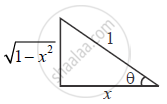
Now consider,
sin ( tan -1 2 )
Let tan-1 2 = Φ
tan Φ = 2
sin ( tan-1 2) = sin Φ = `2/sqrt(5) ` ...(ii)
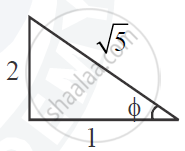
From (i) and (ii)
`sqrt(1- x^2 )/x = 2/sqrt(5)`
5(1 - x2 ) = 4x2
`x = +- sqrt(5)/3 " but " x > 0 ⇒ x = sqrt(5)/3`
APPEARS IN
संबंधित प्रश्न
Find the value of the following: `tan(1/2)[sin^(-1)((2x)/(1+x^2))+cos^(-1)((1-y^2)/(1+y^2))],|x| <1,y>0 and xy <1`
Solve the equation for x:sin−1x+sin−1(1−x)=cos−1x
If tan-1x+tan-1y=π/4,xy<1, then write the value of x+y+xy.
`sin^-1(sin (7pi)/6)`
`sin^-1(sin (13pi)/7)`
Evaluate the following:
`cos^-1{cos ((4pi)/3)}`
Evaluate the following:
`tan^-1(tan (9pi)/4)`
Evaluate the following:
`tan^-1(tan12)`
Evaluate the following:
`sec^-1{sec (-(7pi)/3)}`
Evaluate the following:
`\text(cosec)^-1(\text{cosec} pi/4)`
Evaluate the following:
`cosec^-1(cosec (6pi)/5)`
Write the following in the simplest form:
`tan^-1(x/(a+sqrt(a^2-x^2))),-a<x<a`
Evaluate the following:
`sin(sin^-1 7/25)`
Evaluate:
`cot{sec^-1(-13/5)}`
Evaluate:
`cot(sin^-1 3/4+sec^-1 4/3)`
If `cot(cos^-1 3/5+sin^-1x)=0`, find the values of x.
Prove the following result:
`tan^-1 1/7+tan^-1 1/13=tan^-1 2/9`
Prove the following result:
`sin^-1 12/13+cos^-1 4/5+tan^-1 63/16=pi`
Prove that: `cos^-1 4/5+cos^-1 12/13=cos^-1 33/65`
If `sin^-1 (2a)/(1+a^2)+sin^-1 (2b)/(1+b^2)=2tan^-1x,` Prove that `x=(a+b)/(1-ab).`
Write the value of tan−1x + tan−1 `(1/x)`for x > 0.
Write the value of \[\tan^{- 1} \left\{ 2\sin\left( 2 \cos^{- 1} \frac{\sqrt{3}}{2} \right) \right\}\]
If \[\cos\left( \tan^{- 1} x + \cot^{- 1} \sqrt{3} \right) = 0\] , find the value of x.
Find the value of \[\cos^{- 1} \left( \cos\frac{13\pi}{6} \right)\]
The value of tan \[\left\{ \cos^{- 1} \frac{1}{5\sqrt{2}} - \sin^{- 1} \frac{4}{\sqrt{17}} \right\}\] is
If \[\cos^{- 1} \frac{x}{a} + \cos^{- 1} \frac{y}{b} = \alpha, then\frac{x^2}{a^2} - \frac{2xy}{ab}\cos \alpha + \frac{y^2}{b^2} = \]
If α = \[\tan^{- 1} \left( \tan\frac{5\pi}{4} \right) \text{ and }\beta = \tan^{- 1} \left( - \tan\frac{2\pi}{3} \right)\] , then
If θ = sin−1 {sin (−600°)}, then one of the possible values of θ is
The value of \[\sin\left( 2\left( \tan^{- 1} 0 . 75 \right) \right)\] is equal to
Find : \[\int\frac{2 \cos x}{\left( 1 - \sin x \right) \left( 1 + \sin^2 x \right)}dx\] .
