हिंदी

Find the Value of X, If Tan Sec − 1 ( 1 X ) = Sin ( Tan − 1 2 ) , X > 0 . - Mathematics

Advertisements
Advertisements

प्रश्न

Find the value of x, if tan `[sec^(-1) (1/x) ] = sin ( tan^(-1) 2) , x > 0 `.

योग
Advertisements

उत्तर

Let sec-1 `(1/x) = theta`

` ⇒ sec theta = 1/x`

⇒ cos θ = x 

⇒ tan ` (sec^(-1) (1/x)) = tan theta = sqrt(1 -x^2 ) /x `                ...(1) 
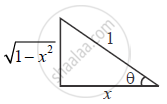
Now consider, 

sin ( tan -1 2 )

Let tan-1 2 = Φ

 tan Φ = 2 

sin ( tan-1 2) = sin Φ = `2/sqrt(5) `            ...(ii) 
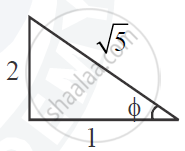
From (i) and (ii)

`sqrt(1- x^2 )/x = 2/sqrt(5)`

5(1 - x) = 4x

`x = +- sqrt(5)/3 " but " x > 0 ⇒ x = sqrt(5)/3`

shaalaa.com
  क्या इस प्रश्न या उत्तर में कोई त्रुटि है?
2018-2019 (March) 65/3/3

वीडियो ट्यूटोरियलVIEW ALL [2]

संबंधित प्रश्न

Solve the following for x :

`tan^(-1)((x-2)/(x-3))+tan^(-1)((x+2)/(x+3))=pi/4,|x|<1`


Find the domain of  `f(x) =2cos^-1 2x+sin^-1x.`


Find the domain of `f(x)=cos^-1x+cosx.`


`sin^-1(sin2)`


Evaluate the following:

`cos^-1(cos4)`


Evaluate the following:

`tan^-1(tan  pi/3)`


Evaluate the following:

`tan^-1(tan1)`


Evaluate the following:

`sec^-1(sec  (25pi)/6)`


Evaluate the following:

`cosec^-1(cosec  (6pi)/5)`


Evaluate the following:

`cot^-1(cot  pi/3)`


Write the following in the simplest form:

`tan^-1(x/(a+sqrt(a^2-x^2))),-a<x<a`


Write the following in the simplest form:

`sin^-1{(x+sqrt(1-x^2))/sqrt2},-1<x<1`


Evaluate the following:

`sin(tan^-1  24/7)`


Evaluate the following:

`sec(sin^-1  12/13)`


Solve: `cos(sin^-1x)=1/6`


`2tan^-1  3/4-tan^-1  17/31=pi/4`


Prove that

`tan^-1((1-x^2)/(2x))+cot^-1((1-x^2)/(2x))=pi/2`


For any a, b, x, y > 0, prove that:

`2/3tan^-1((3ab^2-a^3)/(b^3-3a^2b))+2/3tan^-1((3xy^2-x^3)/(y^3-3x^2y))=tan^-1  (2alphabeta)/(alpha^2-beta^2)`

`where  alpha =-ax+by, beta=bx+ay`


Write the value of tan1 x + tan−1 `(1/x)`  for x < 0.


Write the value of sin (cot−1 x).


Write the value of sin1 (sin 1550°).


Write the value of cos−1 \[\left( \tan\frac{3\pi}{4} \right)\]


Write the value of \[\cos^{- 1} \left( \cos\frac{14\pi}{3} \right)\]


Write the value of  `cot^-1(-x)`  for all `x in R` in terms of `cot^-1(x)`


The positive integral solution of the equation
\[\tan^{- 1} x + \cos^{- 1} \frac{y}{\sqrt{1 + y^2}} = \sin^{- 1} \frac{3}{\sqrt{10}}\text{ is }\]


If α = \[\tan^{- 1} \left( \tan\frac{5\pi}{4} \right) \text{ and }\beta = \tan^{- 1} \left( - \tan\frac{2\pi}{3} \right)\] , then


\[\text{ If }\cos^{- 1} \frac{x}{3} + \cos^{- 1} \frac{y}{2} = \frac{\theta}{2}, \text{ then }4 x^2 - 12xy \cos\frac{\theta}{2} + 9 y^2 =\]


If \[\tan^{- 1} \left( \frac{1}{1 + 1 . 2} \right) + \tan^{- 1} \left( \frac{1}{1 + 2 . 3} \right) + . . . + \tan^{- 1} \left( \frac{1}{1 + n . \left( n + 1 \right)} \right) = \tan^{- 1} \theta\] , then find the value of θ.


Solve for x : {xcos(cot-1 x) + sin(cot-1 x)}= `51/50`


The value of sin `["cos"^-1 (7/25)]` is ____________.


Share
Notifications

Englishहिंदीमराठी


      Forgot password?
Use app×