Find the Value of X in the Following : 2 Sin X/2 = 1
Advertisements
Question
Find the value of x in the following:
`2 sin x/2 = 1`
Advertisements
Solution
We have
`2 sin x/2 = 1`
`=> sin x/2 = 1/2`
Since `sin 30^@ = 1/2`
Therefore
`sin x/2 = 1/2`
`sin x/2 = sin 30^@`
`x/2 = 30^@`
`x = 2 xx 30^@`
`=> x = 60^@`
Therefore
`x = 60^@`
APPEARS IN
RELATED QUESTIONS
If cot θ = `7/8`, evaluate cot2 θ.
State whether the following are true or false. Justify your answer.
sec A = `12/5` for some value of angle A.
In the following, trigonometric ratios is given. Find the value of the other trigonometric ratios.
tan θ = 11
In the following, trigonometric ratios are given. Find the values of the other trigonometric ratios.
`cosec theta = sqrt10`
if `tan theta = 12/13` Find `(2 sin theta cos theta)/(cos^2 theta - sin^2 theta)`
Evaluate the following:
sin 45° sin 30° + cos 45° cos 30°
Evaluate the Following
`sin 30^2/sin 45^@ + tan 45^@/sec 60^@ - sin 60^@/cot 45^@ - cos 30^@/sin 90^@`
Find the value of x in the following:
`sqrt3 tan 2x = cos 60^@ + sin45^@ cos 45^@`
In ΔABC is a right triangle such that ∠C = 90°, ∠A = 45° and BC = 7 units. Find ∠B, AB and AC.
`(1 + tan^2 "A")/(1 + cot^2 "A")` is equal to ______.
3 sin² 20° – 2 tan² 45° + 3 sin² 70° is equal to ______.
If A and (2A – 45°) are acute angles such that sin A = cos (2A – 45°), then tan A is equal to ______.
Given that sinα = `1/2` and cosβ = `1/2`, then the value of (α + β) is ______.
Prove that sec θ + tan θ = `cos θ/(1 - sin θ)`.
Proof: L.H.S. = sec θ + tan θ
= `1/square + square/square`
= `square/square` ......`(∵ sec θ = 1/square, tan θ = square/square)`
= `((1 + sin θ) square)/(cos θ square)` ......[Multiplying `square` with the numerator and denominator]
= `(1^2 - square)/(cos θ square)`
= `square/(cos θ square)`
= `cos θ/(1 - sin θ)` = R.H.S.
∴ L.H.S. = R.H.S.
∴ sec θ + tan θ = `cos θ/(1 - sin θ)`
Find the value of sin 45° + cos 45° + tan 45°.
What will be the value of sin 45° + `1/sqrt(2)`?
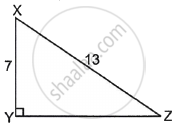
In the given figure, if sin θ = `7/13`, which angle will be θ?
If sin θ + cos θ = `sqrt(2)` then tan θ + cot θ = ______.
If cos(α + β) = `(3/5)`, sin(α – β) = `5/13` and 0 < α, β < `π/4`, then tan (2α) is equal to ______.
If sinθ = `1/sqrt(2)` and `π/2 < θ < π`. Then the value of `(sinθ + cosθ)/tanθ` is ______.
