Advertisements
Advertisements
Question
Find the missing values in the following table for the circles with radius (r), diameter (d) and Circumference (C).
| radius (r) | diameter (d) | Circumference (C) |
| 24 m |
Advertisements
Solution
Given: diameter d = 24 m
radius r = `"d"/2`
= `24/2`
= 12 m
Circumference C = 2πr units
= `2 xx 22/7 xx 12`
= `528/7`
= 75.4 m
Tabulating the results
| radius (r) | diameter (d) | Circumference (C) |
| 12 m | 24 m | 75.42 m |
APPEARS IN
RELATED QUESTIONS
Prove that there is one and only one tangent at any point on the circumference of a circle.
Prove that the tangents at the extremities of any chord make equal angles with the chord.
Write True or False. Give reason for your answer.
Sector is the region between the chord and its corresponding arc.
Find the length of a tangent drawn to a circle with radius 5cm, from a point 13 cm from the center of the circle.
Two tangent segments PA and PB are drawn to a circle with center O such that ∠APB = 120°. Prove that OP = 2AP
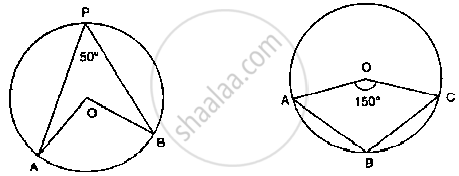
In the below fig. O is the centre of the circle. If ∠APB = 50°, find ∠AOB and ∠OAB.
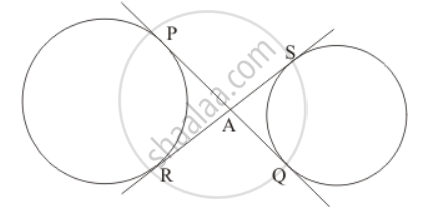
In the given figure, common tangents PQ and RS to two circles intersect at A. Prove that PQ = RS.
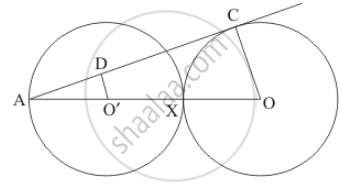
Equal circles with centres O and O' touch each other at X. OO' produced to meet a circle with centre O', at A. AC is a tangent to the circle whose centre is O. O'D is perpendicular to AC. Find the value of\[\frac{DO'}{CO}\]
Suppose you are given a circle. Describe a method by which you can find the center of this circle.
In the given circle with diameter AB, find the value of x.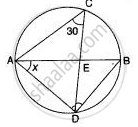
State, if the following statement is true or false:
The diameters of a circle always pass through the same point in the circle.
A line segment which joins any two points on a circle is a ___________
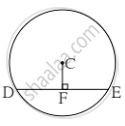
In the adjoining figure, seg DE is the chord of the circle with center C, seg CF ⊥ seg DE and DE = 16 cm, then find the length of DF?
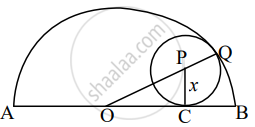
In the figure, a circle with center P touches the semicircle at points Q and C having center O. If diameter AB = 10, AC = 6, then find the radius x of the smaller circle.
C(O, r1) and C(O, r2) are two concentric circles with r1 > r2 AB is a chord of C(O, r1) touching C(O, r2) at C then ______
In the following figure, if AOB is a diameter of the circle and AC = BC, then ∠CAB is equal to ______.

In the following figure, BC is a diameter of the circle and ∠BAO = 60º. Then ∠ADC is equal to ______.
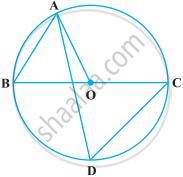
A quadrilateral ABCD is inscribed in a circle such that AB is a diameter and ∠ADC = 130º. Find ∠BAC.
Assertion (A): If the circumference of a circle is 176 cm, then its radius is 28 cm.
Reason (R): Circumference = 2π × radius of a circle.
The circumcentre of a triangle is the point which is ______.
