Advertisements
Advertisements
Question
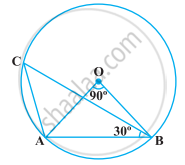
In the following figure, if AOB is a diameter and ∠ADC = 120°, then ∠CAB = 30°.

Options
True
False
Advertisements
Solution
This statement is True.
Explanation:
Let AOB be the diameter of the circle.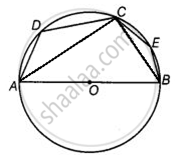
Given: ∠ADC = 120°
Firstly, join CB.
Then, we have a cyclic quadrilateral ABCD.
Since sum of opposite angles of cyclic quadrilateral is 180°, therefore
∠ADC + ∠ABC = 180°
⇒ 120° + ∠ABC = 180°
⇒ ∠ABC = 180° – 120°
⇒ ∠ABC = 60°
Now join AC.
Also, diameter subtends a right angle to the circle,
∴ In ΔABC, ∠ACB = 90°
Now, by angle sum property of a triangle, sum of all angles of a triangle is 180°.
∴ ∠CAB + ∠ABC + ∠ACB = 180°
⇒ ∠CAB + 60° + 90° = 180°
⇒ ∠CAB = 180° – 90° – 60°
⇒ ∠CAB = 30°
APPEARS IN
RELATED QUESTIONS
Write True or False. Give reasons for your answers.
If a circle is divided into three equal arcs, each is a major arc.
Prove that the intercept of a tangent between two parallel tangents to a circle subtends a right angle at center.
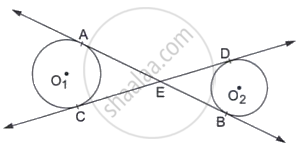
In the given figure, common tangents AB and CD to the two circles with centres O1 and O2 intersect at E. Prove that AB = CD.
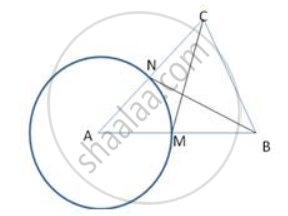
In following fig. ABC is an equilateral triangle . A circle is drawn with centre A so that ot cuts AB and AC at M and N respectively. Prove that BN = CM.
In the figure, O is the centre of a circle and diameter AB bisects the chord CD at a point E such that CE = ED = 8 cm and EB = 4 cm. The radius of the circle is
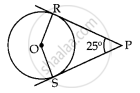
In the given figure, if ZRPS = 25°, the value of ZROS is ______
In the following figure, ∠AOB = 90º and ∠ABC = 30º, then ∠CAO is equal to ______.
If AOB is a diameter of a circle and C is a point on the circle, then AC2 + BC2 = AB2.
From the figure, identify a point in the exterior.

Is every chord of a circle also a diameter?
