Advertisements
Advertisements
Question
Find the missing value.
| Diagonal (d1) | Diagonal (d2) | Area |
| 26 m | 468 sq.m |
Advertisements
Solution
Given diagonal d1 = 26 m
Area of the rhombus = 468 sq.m
`1/2` (d1 × d2) = 468
`1/2` (26 × d2) = 468
(26 × d2) = 468 × 2
d2 = `(468 xx 2)/26`
d2 = 36 m
Tabulating the results we have
| Diagonal (d1) | Diagonal (d2) | Area |
| 26 m | 36 m | 468 sq.m |
APPEARS IN
RELATED QUESTIONS
The perimeter of a rhombus is 40 cm. If one diagonal is 16 cm; find:
- It's other diagonal
- area
The length of the diagonals of a rhombus is in ratio 4 : 3. If its area is 384 cm2, find its side.
Find the area of rhombus PQRS shown in the following figure.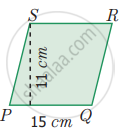
The area of the rhombus is 128 sq.cm and the length of one diagonal is 32 cm. The length of the other diagonal is
The angle between the diagonals of a rhombus is
The area of the rhombus is 576 sq.cm and the length of one of its diagonal is half of the length of the other diagonal then find the length of the diagonal
A man has to build a rhombus shaped swimming pool. One of the diagonal is 13 m and the other is twice the first one. Then find the area of the swimming pool and also find the cost of cementing the floor at the rate of ₹ 15 per sq.cm
What is the area of the rhombus ABCD below if AC = 6 cm and BE = 4 cm?
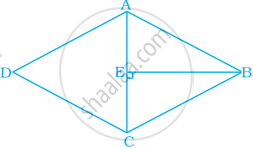
Area of a rhombus = `1/2` product of ______.
The area of a rectangular field is 48 m2 and one of its sides is 6 m. How long will a lady take to cross the field diagonally at the rate of 20 m/minute?
