English

Find the equation of a curve passing through the point (1, 1). If the tangent drawn at any point P(x, y) on the curve meets the co-ordinate axes at A and B such that P is the mid-point of AB. - Mathematics

Advertisements
Advertisements

Question

Find the equation of a curve passing through the point (1, 1). If the tangent drawn at any point P(x, y) on the curve meets the co-ordinate axes at A and B such that P is the mid-point of AB.

Sum
Advertisements

Solution
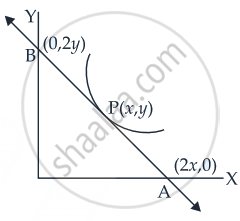

Let P (x, y) be any point on the curve and AB be the tangent to the given curve at P.

P is the midpoint of AB  .....(Given)

∴ Coordinates of A and B are (2x, 0) and (0, 2y) respectively.

∴ Slope of the tangent AB = `(2y - 0)/(0 - 2x) = - y/x`

∴ `("d"y)/("d"x) = - y/x`

⇒ `("d"y)/y = -("d"x)/x`

Integrating both sides, we get

`int ("d"y)/y = -int ("d"x)/x`

⇒ log y = – log x + log c

⇒ log y + log x = log c

⇒ log yx = log c

∴ yx = c

Since, the curve passes through (1, 1)

∴ 1 × 1 = c

∴ c = 1

Hence, the required equation is xy = 1.

shaalaa.com
  Is there an error in this question or solution?
Chapter 9: Differential Equations - Exercise [Page 195]

APPEARS IN

NCERT Exemplar Mathematics [English] Class 12
Chapter 9 Differential Equations
Exercise | Q 32 | Page 195

RELATED QUESTIONS

Form the differential equation of the family of parabolas having vertex at origin and axis along positive y-axis.


Form the differential equation of the family of hyperbolas having foci on x-axis and centre at origin.


For the curve y = 5x – 2x3, if x increases at the rate of 2 units/sec, then find the rate of change of the slope of the curve when x = 3


Show that the family of curves for which `dy/dx = (x^2+y^2)/(2x^2)` is given by  x2 - y2 = cx


Form the differential equation of the family of curves represented by y2 = (x − c)3.


Form the differential equation from the following primitive where constants are arbitrary:
y = cx + 2c2 + c3


Form the differential equation from the following primitive where constants are arbitrary:
xy = a2


Form the differential equation from the following primitive where constants are arbitrary:
y = ax2 + bx + c


Find the differential equation of the family of curves y = Ae2x + Be−2x, where A and B are arbitrary constants.


Form the differential equation corresponding to (x − a)2 + (y − b)2 = r2 by eliminating a and b.


Form the differential equation of the family of curves represented by the equation (a being the parameter):
(2x + a)2 + y2 = a2


Form the differential equation of the family of curves represented by the equation (a being the parameter):
(2x − a)2 − y2 = a2


Represent the following families of curves by forming the corresponding differential equations (a, b being parameters):

\[\frac{x^2}{a^2} - \frac{y^2}{b^2} = 1\]


Represent the following families of curves by forming the corresponding differential equations (a, b being parameters):
y = ax3


Represent the following families of curves by forming the corresponding differential equations (a, b being parameters):
x2 + y2 = ax3


Find the equation of a curve passing through the point (0, 0) and whose differential equation is \[\frac{dy}{dx} = e^x \sin x\]


Find one-parameter families of solution curves of the following differential equation:-

\[\frac{dy}{dx} - y = \cos 2x\]


Find one-parameter families of solution curves of the following differential equation:-

\[x \log x\frac{dy}{dx} + y = 2 \log x\]


Find one-parameter families of solution curves of the following differential equation:-

\[x\frac{dy}{dx} + 2y = x^2 \log x\]


Find the area of the region bounded by the curves (x -1)2 + y2 = 1 and x2 + y2 = 1, using integration.


Form the differential equation by eliminating A and B in Ax2 + By2 = 1


Find the differential equation of system of concentric circles with centre (1, 2).


Find the equation of a curve passing through (2, 1) if the slope of the tangent to the curve at any point (x, y) is `(x^2 + y^2)/(2xy)`.


The differential equation of the family of curves x2 + y2 – 2ay = 0, where a is arbitrary constant, is ______.


The curve for which the slope of the tangent at any point is equal to the ratio of the abcissa to the ordinate of the point is ______.


The differential equation representing the family of circles x2 + (y – a)2 = a2 will be of order two.


From the differential equation of the family of circles touching the y-axis at origin


Form the differential equation of family of circles having centre on y-axis and raduis 3 units


Share
Notifications

Englishहिंदीमराठी


      Forgot password?
Use app×