English

Form the Differential Equation of the Family of Circles Touching the Y-axis at the Origin. - Mathematics

Advertisements
Advertisements

Question

Form the differential equation of the family of circles touching the y-axis at the origin.

Advertisements

Solution

The centre of the circle touching the y-axis at origin lies on the x-axis.

Let (a, 0) be the centre of the circle.

Since it touches the y-axis at origin, its radius is a.

Now, the equation of the circle with centre (a, 0) and radius (a) is
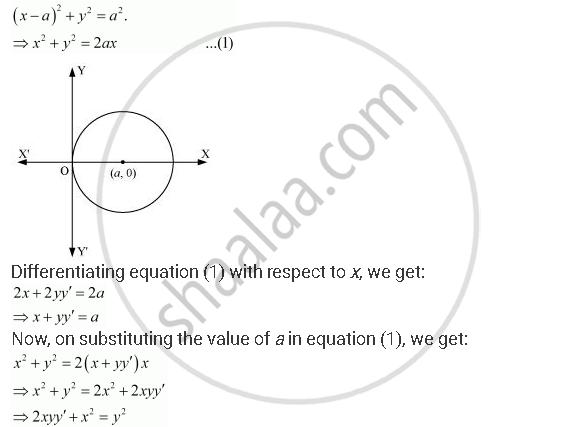
This is the required differential equation.

shaalaa.com
  Is there an error in this question or solution?
Chapter 9: Differential Equations - Exercise 9.3 [Page 391]

APPEARS IN

NCERT Mathematics Part 1 and 2 [English] Class 12
Chapter 9 Differential Equations
Exercise 9.3 | Q 6 | Page 391

RELATED QUESTIONS

Form the differential equation of the family of circles having centre on y-axis and radius 3 units.


Which of the following differential equations has y = c1 ex + c2 e–x as the general solution?

(A) `(d^2y)/(dx^2) + y = 0`

(B) `(d^2y)/(dx^2) - y = 0`

(C) `(d^2y)/(dx^2) + 1 = 0`

(D) `(d^2y)/(dx^2)  - 1 = 0`


Form the differential equation representing the family of curves given by (x – a)2 + 2y2 = a2, where a is an arbitrary constant.


Form the differential equation of the family of curves represented by y2 = (x − c)3.


Form the differential equation from the following primitive where constants are arbitrary:
y2 = 4ax


Form the differential equation from the following primitive where constants are arbitrary:
xy = a2


Form the differential equation from the following primitive where constants are arbitrary:
y = ax2 + bx + c


Find the differential equation of the family of curves y = Ae2x + Be−2x, where A and B are arbitrary constants.


Form the differential equation corresponding to y2 = a (b − x2) by eliminating a and b.


Form the differential equation corresponding to y2 − 2ay + x2 = a2 by eliminating a.


Form the differential equation corresponding to (x − a)2 + (y − b)2 = r2 by eliminating a and b.


Form the differential equation of the family of curves represented by the equation (a being the parameter):
(2x + a)2 + y2 = a2


Form the differential equation of the family of curves represented by the equation (a being the parameter):
(2x − a)2 − y2 = a2


Form the differential equation of the family of curves represented by the equation (a being the parameter):
 (x − a)2 + 2y2 = a2


Represent the following families of curves by forming the corresponding differential equations (a, b being parameters):
y2 = 4ax


Represent the following families of curves by forming the corresponding differential equations (a, b being parameters):

\[\frac{x^2}{a^2} - \frac{y^2}{b^2} = 1\]


Represent the following families of curves by forming the corresponding differential equations (a, b being parameters):
x2 + y2 = ax3


Form the differential equation of the family of circles in the second quadrant and touching the coordinate axes.


Show that y = bex + ce2x is a solution of the differential equation, \[\frac{d^2 y}{d x^2} - 3\frac{dy}{dx} + 2y = 0\]


Find one-parameter families of solution curves of the following differential equation:-

\[x\frac{dy}{dx} - y = \left( x + 1 \right) e^{- x}\]


Find one-parameter families of solution curves of the following differential equation:-

\[\left( x \log x \right)\frac{dy}{dx} + y = \log x\]


Find one-parameter families of solution curves of the following differential equation:-

\[x\frac{dy}{dx} + 2y = x^2 \log x\]


Write the order of the differential equation representing the family of curves y = ax + a3.


Form the differential equation of the family of hyperbolas having foci on x-axis and centre at the origin.


Form the differential equation representing the family of curves y = A sin x, by eliminating the arbitrary constant A.


Find the differential equation of the family of lines through the origin.


Find the equation of a curve passing through (2, 1) if the slope of the tangent to the curve at any point (x, y) is `(x^2 + y^2)/(2xy)`.


Family y = Ax + A3 of curves will correspond to a differential equation of order ______.


The curve for which the slope of the tangent at any point is equal to the ratio of the abcissa to the ordinate of the point is ______.


The differential equation of the family of curves y2 = 4a(x + a) is ______.


Differential equation representing the family of curves y = ex (Acosx + Bsinx) is `("d"^2y)/("d"x^2) - 2 ("d"y)/("d"x) + 2y` = 0


The area above the x-axis and under the curve `y = sqrt(1/x - 1)` for `1/2 ≤ x ≤ 1` is:


Form the differential equation of family of circles having centre on y-axis and raduis 3 units


Share
Notifications

Englishहिंदीमराठी


      Forgot password?
Use app×