Advertisements
Advertisements
Question
Find the area of the right-angled triangle with a hypotenuse of 40 cm and one of the other two sides of 24 cm.
Advertisements
Solution
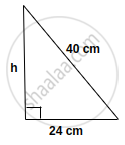
by applying Pythagoras' theorem,
H2 = P2 + B2
402 = P2 + 242
P2 = 402 - 242
= (40 - 24) (40 + 24)
= 16 × 64 = 1024 cm2
P = `sqrt1024 = 32` cm
A = `1/2 xx "b" xx "h"`
= `1/2 xx 24 xx 32`
= `12 xx 32`
= 384 cm2
APPEARS IN
RELATED QUESTIONS
Calculate the area and the height of an equilateral triangle whose perimeter is 60 cm.
ABC is a triangle in which AB = AC = 4 cm and ∠A = 90°. Calculate:
(i) The area of ΔABC,
(ii) The length of the perpendicular from A to BC.
The perimeter of a triangle is 450 m and its side are in the ratio 12: 5: 13. Find the area of the triangle.
The perimeter of a triangle is 72cm and its sides are in the ratio 3:4:5. Find its area and the length of the altitude corresponding to the longest side.
The table given below contains some measures of the triangle. Find the unknown values.
| Side 1 | Side 2 | Side 3 | Perimeter |
| 6 cm | 5 cm | 2 cm | ? |
The table given below contains some measures of the triangle. Find the unknown values.
| Side 1 | Side 2 | Side 3 | Perimeter |
| 11 feet | ? | 9 feet | 28 feet |
Find the perimeter of An isosceles triangle with equal sides 10 cm each and third side is 7 cm
The scalene triangle has 40 cm as its perimeter and whose two sides are 13 cm and 15 cm, find the third side
From one vertex of an equilateral triangle with side 40 cm, an equilateral triangle with 6 cm side is removed. What is the perimeter of the remaining portion?
Find the perimeter of the triangle, whose sides are 13 cm, 5 cm and 14 cm
