Advertisements
Advertisements
Question
One of the equal sides of an isosceles triangle is 13 cm and its perimeter is 50 cm. Find the area of the triangle.
Advertisements
Solution
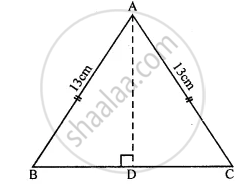
In isosceles ∆ABC
AB = AC = 13 cm But perimeter = 50 cm
∴ BC = 50 - (13 + 13) cm
= 50 - 26 = 24 cm
AD ⊥ BC
∴ AD = DC = `24/2 = 12` cm.
In right ΔABD,
AB2 = AD2 + BD2 (Pythagoras Therorem)
`(13)^2 = "AD"^2 + (12)^2`
⇒ 169 = `"AD"^2 + 144`
⇒ `"AD"^2 = 169 - 144`
= 25 = (5)2
∴ AD = 5 cm.
Now area of ΔABC = `1/2 "Base" xx "Altitude"`
= `1/2 xx "BC" xx "AD"`
= `1/2 xx 24 xx 5 = 60` cm2
APPEARS IN
RELATED QUESTIONS
Find the area of a triangle whose sides are 18 cm, 24 cm, and 30 cm. Also, find the length of altitude corresponding to the largest side of the triangle.
If the difference between the sides of a right-angled triangle is 3 cm and its area is 54 cm2; find its perimeter.
The base of a triangular field is three times its height. If the cost of cultivating the field at ₹ 36.72 per 100 m2 is ₹ 49,572; find its base and height.
The perimeter of a triangle is 450 m and its side are in the ratio 12: 5: 13. Find the area of the triangle.
Find the area of a triangle, whose sides are :
18 mm, 24 mm and 30 mm
The lengths of the sides of a triangle are in the ratio 4: 5 : 3 and its perimeter is 96 cm. Find its area.
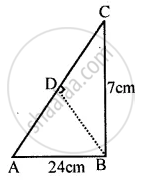
Use the information given in the adjoining figure to find :
(i) the length of AC.
(ii) the area of an ∆ABC
(iii) the length of BD, correct to one decimal place.
The perimeter of a triangle is 72cm and its sides are in the ratio 3:4:5. Find its area and the length of the altitude corresponding to the longest side.
Find the perimeter of A scalene triangle with sides 7 m, 8 m, 10 m
The perimeter of a triangle is 28 cm. One of it’s sides is 8 cm. Write all the sides of the possible isosceles triangles with these measurements.
