Advertisements
Advertisements
प्रश्न
One of the equal sides of an isosceles triangle is 13 cm and its perimeter is 50 cm. Find the area of the triangle.
Advertisements
उत्तर
In isosceles ∆ABC
AB = AC = 13 cm But perimeter = 50 cm
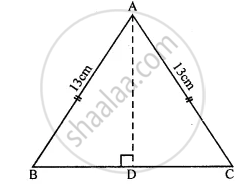
∴ BC = 50 - (13 + 13) cm
= 50 - 26 = 24 cm
AD ⊥ BC
∴ AD = DC = `24/2 = 12` cm.
In right ΔABD,
AB2 = AD2 + BD2 (Pythagoras Therorem)
`(13)^2 = "AD"^2 + (12)^2`
⇒ 169 = `"AD"^2 + 144`
⇒ `"AD"^2 = 169 - 144`
= 25 = (5)2
∴ AD = 5 cm.
Now area of ΔABC = `1/2 "Base" xx "Altitude"`
= `1/2 xx "BC" xx "AD"`
= `1/2 xx 24 xx 5 = 60` cm2
APPEARS IN
संबंधित प्रश्न
Find the area of an isosceles triangle with perimeter is 36 cm and the base is 16 cm.
The lengths of the sides of a triangle are in the ratio 4: 5 : 3 and its perimeter is 96 cm. Find its area.
Find the area of the right-angled triangle with a hypotenuse of 40 cm and one of the other two sides of 24 cm.
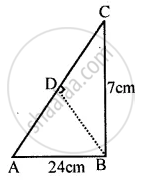
Use the information given in the adjoining figure to find :
(i) the length of AC.
(ii) the area of an ∆ABC
(iii) the length of BD, correct to one decimal place.
Find the area of a right angled triangle whose hypotenuse is 15cm and the base is 9cm.
The table given below contains some measures of the triangle. Find the unknown values.
| Side 1 | Side 2 | Side 3 | Perimeter |
| 11 feet | ? | 9 feet | 28 feet |
The scalene triangle has 40 cm as its perimeter and whose two sides are 13 cm and 15 cm, find the third side
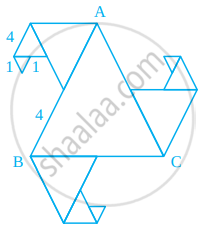
In the following figure, all triangles are equilateral and AB = 8 units. Other triangles have been formed by taking the mid points of the sides. What is the perimeter of the figure?
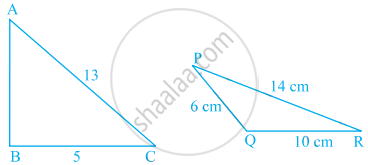
In the following figures, perimeter of ΔABC = perimeter of ΔPQR. Find the area of ΔABC.
Area of an isosceles triangle is 48 cm2. If the altitudes corresponding to the base of the triangle is 8 cm, find the perimeter of the triangle.
