Advertisements
Advertisements
प्रश्न
Find the area of the right-angled triangle with a hypotenuse of 40 cm and one of the other two sides of 24 cm.
Advertisements
उत्तर
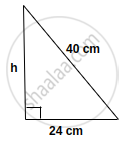
by applying Pythagoras' theorem,
H2 = P2 + B2
402 = P2 + 242
P2 = 402 - 242
= (40 - 24) (40 + 24)
= 16 × 64 = 1024 cm2
P = `sqrt1024 = 32` cm
A = `1/2 xx "b" xx "h"`
= `1/2 xx 24 xx 32`
= `12 xx 32`
= 384 cm2
APPEARS IN
संबंधित प्रश्न
Find the area of a triangle whose sides are 18 cm, 24 cm, and 30 cm. Also, find the length of altitude corresponding to the largest side of the triangle.
ABC is a triangle in which AB = AC = 4 cm and ∠A = 90°. Calculate:
(i) The area of ΔABC,
(ii) The length of the perpendicular from A to BC.
Find the area and the perimeter of quadrilateral ABCD, given below; if AB = 8 cm, AD = 10 cm, BD = 12 cm, DC = 13 cm and ∠DBC = 90°.
The given figure shows a right-angled triangle ABC and an equilateral triangle BCD. Find the area of the shaded portion.

The base and the height of a triangle are in the ratio 5 : 3. If the area of the triangle is 67.5 m2; find its base and height.
Find the perimeter of the triangle, whose sides are 13 cm, 5 cm and 14 cm
Find the perimeter of a triangle with sides measuring 10 cm, 14 cm and 15 cm.
A piece of string is 30 cm long. What will be the length of each side if the string is used to form an equilateral triangle?
Two sides of a triangle are 12 cm and 14 cm. The perimeter of the triangle is 36 cm. What is its third side?
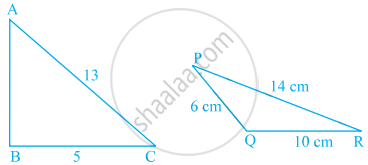
In the following figures, perimeter of ΔABC = perimeter of ΔPQR. Find the area of ΔABC.