Advertisements
Advertisements
Question
Find the area of the irregular polygon shaped fields given below.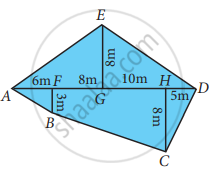
Advertisements
Solution
Area of the field = Area of trapezium FBCH + Area of ∆DHC + Area of ∆EGD + Area of ∆EGA + Area of ∆BFA
Area of the triangle = `1/2 "bh sq. units"`
Area of the trapezium = `1/2 xx "h" xx ("a" + "b") "sq. units"`
Area of the trapezium FBCH = `1/2 xx (10 + 8) xx (8 + 3) "m"^2`
= 9 × 11 = 99 m2 ...(1)
Area of the ∆DHC = `1/2 xx 8 xx 5 "m"^2`
= 20 m2 ...(2)
Area of ∆EGD = `1/2 xx 8 xx 15 "m"^2`
= 60 m2 ....(3)
Area of ∆EGA = `1/2 xx 8 xx (8 + 6) "m"^2`
= 4 × 14 m2
= 56 m2
Area of ∆BFA = `1/2 xx 3 xx 6 "m"^2`
= 9 m2
∴ Area of the field = 99 + 20 + 60 + 56 + 9 m2
= 244 m2
Area of the field = 244 m2
APPEARS IN
RELATED QUESTIONS
Find the perimeter and area of the figure given below. `(pi = 22/7)`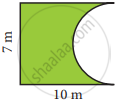
Find the area of the shaded part in the following figure. (π = 3.14)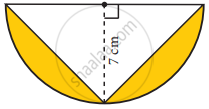
Find the area of the combined figure given which is got by joining of two parallelograms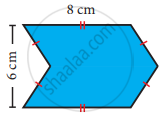
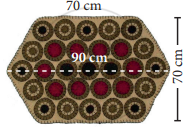
The doormat which is in a hexagonal shape has the following measures as given in the figure. Find its area.
A rocket drawing has the measures as given in the figure. Find its area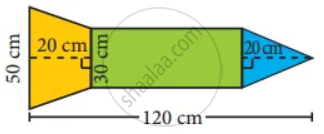
Find the perimeter and area of the following shape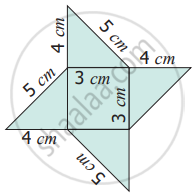
A square of side 2 cm is joined with a rectangle of length 15 cm and breadth 10 cm. Find the perimeter of the combined shape
The following figure are of equal area. Which figure has the least perimeter?
A closed shape has 20 equal sides and one of its sides is 3 cm. Find its perimeter
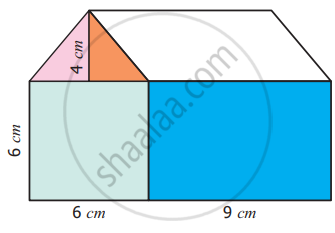
Look at the picture of the house given and find the total area of the shaded portion.