Advertisements
Advertisements
प्रश्न
Find the area of the irregular polygon shaped fields given below.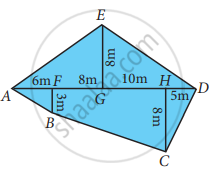
Advertisements
उत्तर
Area of the field = Area of trapezium FBCH + Area of ∆DHC + Area of ∆EGD + Area of ∆EGA + Area of ∆BFA
Area of the triangle = `1/2 "bh sq. units"`
Area of the trapezium = `1/2 xx "h" xx ("a" + "b") "sq. units"`
Area of the trapezium FBCH = `1/2 xx (10 + 8) xx (8 + 3) "m"^2`
= 9 × 11 = 99 m2 ...(1)
Area of the ∆DHC = `1/2 xx 8 xx 5 "m"^2`
= 20 m2 ...(2)
Area of ∆EGD = `1/2 xx 8 xx 15 "m"^2`
= 60 m2 ....(3)
Area of ∆EGA = `1/2 xx 8 xx (8 + 6) "m"^2`
= 4 × 14 m2
= 56 m2
Area of ∆BFA = `1/2 xx 3 xx 6 "m"^2`
= 9 m2
∴ Area of the field = 99 + 20 + 60 + 56 + 9 m2
= 244 m2
Area of the field = 244 m2
APPEARS IN
संबंधित प्रश्न
Find the perimeter and area of the figure given below. `(pi = 22/7)`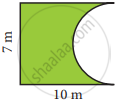
Find the area of the shaded part in the following figure. (π = 3.14)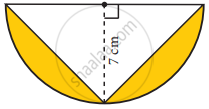
Find the area of the combined figure given which is got by joining of two parallelograms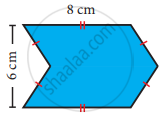
Find the area of the combined figure given, formed by joining a semicircle of diameter 6 cm with a triangle of base 6 cm and height 9 cm. (π = 3.14)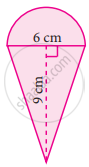
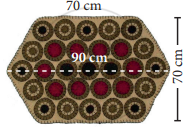
The doormat which is in a hexagonal shape has the following measures as given in the figure. Find its area.
A rocket drawing has the measures as given in the figure. Find its area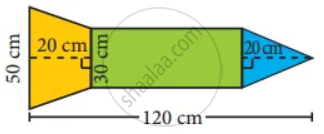
Find the perimeter and area of the following shape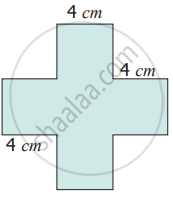
Find the perimeter and area of the following shape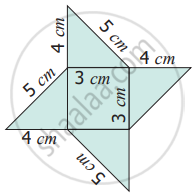
The following figure are of equal area. Which figure has the least perimeter?
If two identical rectangles of perimeter 30 cm are joined together, then the perimeter of the new shape will be
