English

Find the Distance of the Point (−1, −5, −­10) from the Point of Intersection of the Line `Vecr = 2hati -hatj + 2hatk + Lambda(3hati + 4hatj + 2hatk)` and the Plane `Vecr.(Hati -hatj + Hatk) = 5` - Mathematics

Advertisements
Advertisements

Question

Find the distance of the point (−1, −5, −­10) from the point of intersection of the line `vecr = 2hati -hatj + 2hatk + lambda(3hati + 4hatj + 2hatk)` and the plane `vecr.(hati -hatj + hatk) = 5`.

Advertisements

Solution

The equation of the given line is

`vecr = 2hati -hatj + 2hatk + lambda(3hati + 4hatj + 2hatk)`

The equation of the given plane is

`vecr.(hati -hatj + hatk) = 5`

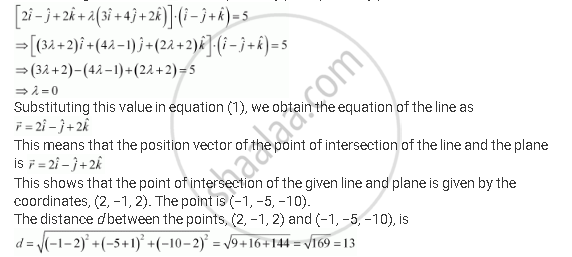
Substituting the value of  `vecr`  from equation (1) in equation (2), we obtain
 

shaalaa.com
  Is there an error in this question or solution?
Chapter 11: Three Dimensional Geometry - Exercise 11.4 [Page 499]

APPEARS IN

NCERT Mathematics Part 1 and 2 [English] Class 12
Chapter 11 Three Dimensional Geometry
Exercise 11.4 | Q 18 | Page 499

RELATED QUESTIONS

Find the distance between the point (7, 2, 4) and the plane determined by the points A(2, 5, −3), B(−2, −3, 5) and C(5, 3, −3).


Find the equation of the planes parallel to the plane x + 2y+ 2z + 8 =0 which are at the distance of 2  units from the point (1,1, 2)


Find the equation of the plane through the line of intersection of the planes x + y + z = 1 and 2x + 3y + 4z = 5 which is perpendicular to the plane x − y + z = 0. Also find the distance of the plane, obtained above, from the origin.


Show that the points (1, –1, 3) and (3, 4, 3) are equidistant from the plane 5x + 2y – 7z + 8 = 0


Find the distance of the point (1, 2, –1) from the plane x - 2y + 4z - 10 = 0 .


Find the distance of the point  \[2 \hat{i} - \hat{j} - 4 \hat{k}\]  from the plane  \[\vec{r} \cdot \left( 3 \hat{i}  - 4 \hat{j}  + 12 \hat{k}  \right) - 9 = 0 .\]


Find the distance of the point (2, 3, −5) from the plane x + 2y − 2z − 9 = 0.


Find the equations of the planes parallel to the plane x − 2y + 2z − 3 = 0 and which are at a unit distance from the point (1, 1, 1).


Find the distance of the point (1, −2, 3) from the plane x − y + z = 5 measured parallel to the line whose direction cosines are proportional to 2, 3, −6.


Find the distance between the point (7, 2, 4) and the plane determined by the points A(2, 5, −3), B(−2, −3, 5) and C (5, 3, −3). 


Find the distance between the parallel planes 2x − y + 3z − 4 = 0 and 6x − 3y + 9z + 13 = 0.


Find the equation of the plane which passes through the point (3, 4, −1) and is parallel to the plane 2x − 3y + 5z + 7 = 0. Also, find the distance between the two planes.


Find the equation of the plane mid-parallel to the planes 2x − 2y + z + 3 = 0 and 2x − 2y + z + 9 = 0.


The distance between the planes 2x + 2y − z + 2 = 0 and 4x + 4y − 2z + 5 = 0 is 


The image of the point (1, 3, 4) in the plane 2x − y + z + 3 = 0 is


 The distance between the point (3, 4, 5) and the point where the line \[\frac{x - 3}{1} = \frac{y - 4}{2} = \frac{z - 5}{2}\] meets the plane x + y + z = 17 is

If a plane passes through the point (1, 1, 1) and is perpendicular to the line \[\frac{x - 1}{3} = \frac{y - 1}{0} = \frac{z - 1}{4}\] then its perpendicular distance from the origin is ______.


Solve the following :

Find the distance of the point (13, 13, – 13) from the plane 3x + 4y – 12z = 0.


The equations of planes parallel to the plane x + 2y + 2z + 8 = 0, which are at a distance of 2 units from the point (1, 1, 2) are ________.


The distance of a point P(a, b, c) from x-axis is ______.


Find the distance of a point (2, 4, –1) from the line `(x + 5)/1 = (y + 3)/4 = (z - 6)/(-9)`


Find the equation of the plane passing through the point (1, 1, 1) and is perpendicular to the line `("x" - 1)/3 = ("y" - 2)/0 = ("z" - 3)/4`. Also, find the distance of this plane from the origin.


A metro train starts from rest and in 5 s achieves 108 km/h. After that it moves with constant velocity and comes to rest after travelling 45 m with uniform retardation. If total distance travelled is 395 m, find total time of travelling.


The fuel charges for running a train are proportional to the square of the speed generated in miles per hour and costs ₹ 48 per hour at 16 miles per hour. The most economical speed if the fixed charges i.e. salaries etc. amount to ₹ 300 per hour is


If the distance of the point (1, 1, 1) from the plane x – y + z + λ = 0 is `5/sqrt(3)`, find the value(s) of λ.


The acute angle between the line `vecr = (hati + 2hatj + hatk) + λ(hati + hatj + hatk)` and the plane `vecr xx (2hati - hatj + hatk)` is ______.


Find the coordinates of points on line `x/1 = (y - 1)/2 = (z + 1)/2` which are at a distance of `sqrt(11)` units from origin.


If the points (1, 1, λ) and (–3, 0, 1) are equidistant from the plane `barr*(3hati + 4hatj - 12hatk) + 13` = 0, find the value of λ.


The distance of the point `2hati + hatj - hatk` from the plane `vecr.(hati - 2hatj + 4hatk)` = 9 will be ______.


Find the equations of the planes parallel to the plane x – 2y + 2z – 4 = 0 which is a unit distance from the point (1, 2, 3).


A plane passes through (1,-2,1) and is perpendicular to the planes 2x - 2y + z = 0 and x - y + 2z = 4. The distance of the point (1, 2, 2) from this plane is______ units.


Share
Notifications

Englishहिंदीमराठी


      Forgot password?
Use app×