Advertisements
Advertisements
प्रश्न
Find the distance of the point (−1, −5, −10) from the point of intersection of the line `vecr = 2hati -hatj + 2hatk + lambda(3hati + 4hatj + 2hatk)` and the plane `vecr.(hati -hatj + hatk) = 5`.
Advertisements
उत्तर
The equation of the given line is
`vecr = 2hati -hatj + 2hatk + lambda(3hati + 4hatj + 2hatk)`
The equation of the given plane is
`vecr.(hati -hatj + hatk) = 5`
Substituting the value of `vecr` from equation (1) in equation (2), we obtain
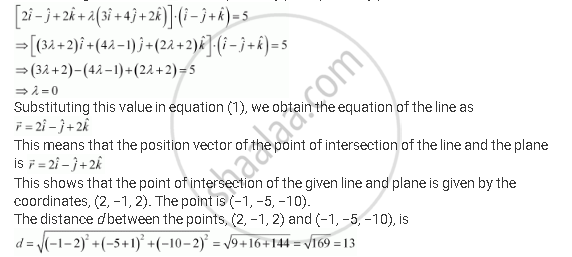
APPEARS IN
संबंधित प्रश्न
Find the distance between the point (7, 2, 4) and the plane determined by the points A(2, 5, −3), B(−2, −3, 5) and C(5, 3, −3).
Find the distance of a point (2, 5, −3) from the plane `vec r.(6hati-3hatj+2 hatk)=4`
In the given cases, find the distance of each of the given points from the corresponding given plane
Point Plane
(3, – 2, 1) 2x – y + 2z + 3 = 0
In the given cases, find the distance of each of the given points from the corresponding given plane.
Point Plane
(2, 3, – 5) x + 2y – 2z = 9
In the given cases, find the distance of each of the given points from the corresponding given plane.
Point Plane
(– 6, 0, 0) 2x – 3y + 6z – 2 = 0
Distance between the two planes: 2x + 3y + 4z = 4 and 4x + 6y + 8z = 12 is
(A) 2 units
(B) 4 units
(C) 8 units
(D)`2/sqrt29 "units"`
Show that the points (1, –1, 3) and (3, 4, 3) are equidistant from the plane 5x + 2y – 7z + 8 = 0
Write the equation of a plane which is at a distance of \[5\sqrt{3}\] units from origin and the normal to which is equally inclined to coordinate axes.
Find the distance of the point \[2 \hat{i} - \hat{j} - 4 \hat{k}\] from the plane \[\vec{r} \cdot \left( 3 \hat{i} - 4 \hat{j} + 12 \hat{k} \right) - 9 = 0 .\]
Find the distance of the point (2, 3, −5) from the plane x + 2y − 2z − 9 = 0.
Find the equations of the planes parallel to the plane x + 2y − 2z + 8 = 0 that are at a distance of 2 units from the point (2, 1, 1).
Find the distance of the point (1, −2, 3) from the plane x − y + z = 5 measured parallel to the line whose direction cosines are proportional to 2, 3, −6.
Find an equation for the set of all points that are equidistant from the planes 3x − 4y + 12z = 6 and 4x + 3z = 7.
Find the distance between the parallel planes 2x − y + 3z − 4 = 0 and 6x − 3y + 9z + 13 = 0.
Find the equation of the plane which passes through the point (3, 4, −1) and is parallel to the plane 2x − 3y + 5z + 7 = 0. Also, find the distance between the two planes.
Find the equation of the plane mid-parallel to the planes 2x − 2y + z + 3 = 0 and 2x − 2y + z + 9 = 0.
The distance between the planes 2x + 2y − z + 2 = 0 and 4x + 4y − 2z + 5 = 0 is
The distance of the line \[\vec{r} = 2 \hat{i} - 2 \hat{j} + 3 \hat{k} + \lambda\left( \hat{i} - \hat{j}+ 4 \hat{k} \right)\] from the plane \[\vec{r} \cdot \left( \hat{i} + 5 \hat{j} + \hat{k} \right) = 5\] is
If a plane passes through the point (1, 1, 1) and is perpendicular to the line \[\frac{x - 1}{3} = \frac{y - 1}{0} = \frac{z - 1}{4}\] then its perpendicular distance from the origin is ______.
Write the coordinates of the point which is the reflection of the point (α, β, γ) in the XZ-plane.
Find the distance of the point (1, 1 –1) from the plane 3x +4y – 12z + 20 = 0.
Solve the following:
Find the distance of the point `3hat"i" + 3hat"j" + hat"k"` from the plane `bar"r".(2hat"i" + 3hat"j" + 6hat"k")` = 21.
Find the distance of the point whose position vector is `(2hat"i" + hat"j" - hat"k")` from the plane `vec"r" * (hat"i" - 2hat"j" + 4hat"k")` = 9
Find the distance of the point (– 2, 4, – 5) from the line `(x + 3)/3 = (y - 4)/5 = (z + 8)/6`
The distance of a point P(a, b, c) from x-axis is ______.
Distance of the point (α, β, γ) from y-axis is ____________.
Find the foot of the perpendicular from the point (1, 2, 0) upon the plane x – 3y + 2z = 9. Hence, find the distance of the point (1, 2, 0) from the given plane.
S and S are the focii of the ellipse `x^2/a^2 + y^2/b^2 - 1` whose one of the ends of the minor axis is the point B If ∠SBS' = 90°, then the eccentricity of the ellipse is
The fuel charges for running a train are proportional to the square of the speed generated in miles per hour and costs ₹ 48 per hour at 16 miles per hour. The most economical speed if the fixed charges i.e. salaries etc. amount to ₹ 300 per hour is
Find the distance of the point (1, –2, 0) from the point of the line `vecr = 4hati + 2hatj + 7hatk + λ(3hati + 4hatj + 2hatk)` and the point `vecr.(hati - hatj + hatk)` = 10.
If the points (1, 1, λ) and (–3, 0, 1) are equidistant from the plane `barr*(3hati + 4hatj - 12hatk) + 13` = 0, find the value of λ.
Find the equations of the planes parallel to the plane x – 2y + 2z – 4 = 0 which is a unit distance from the point (1, 2, 3).
In the figure given below, if the coordinates of the point P are (a, b, c), then what are the perpendicular distances of P from XY, YZ and ZX planes respectively?

A plane passes through (1,-2,1) and is perpendicular to the planes 2x - 2y + z = 0 and x - y + 2z = 4. The distance of the point (1, 2, 2) from this plane is______ units.
