Advertisements
Advertisements
Question
Find the area of a rhombus whose side is 6 cm and whose altitude is 4 cm. If one of its diagonals is 8 cm long, find the length of the other diagonal.
Advertisements
Solution
Given:
Side of the rhombus = 6 cm
Altitude = 4 cm
One of the diagonals = 8 cm
Area of the rhombus = Side x Altitude \[= 6 x 4 = 24 {cm}^2 . . . . . . . . (i)\]
We know: Area of rhombus \[= \frac{1}{2} \times d_1 \times d_2 \]
Using (i):
\[24 = \frac{1}{2} \times d_1 \times d_2 \]
\[24 = \frac{1}{2} \times 8 \times d_2 \]
\[ d_2 = 6 cm\]
RELATED QUESTIONS
The diagonals of a rhombus are 7.5 cm and 12 cm. Find its area.
Find the area of a rhombus whose side is 5 cm and whose altitude is 4.8 cm. If one of its diagonals is 8 cm long, find the length of the other diagonal.
The floor of a building consists of 3000 tiles, which are rhombus shaped, and each of its diagonals are 45 cm and 30 cm in length. Find the total cost of polishing the floor if the cost per m2 is ₹ 4.
The area of a rhombus is 240 cm2 and one of the diagonal is 16 cm. Find another diagonal.
The floor of a building consists of 3000 tiles which are rhombus shaped and each of its diagonals are 45 cm and 30 cm in length. Find the total cost of polishing the floor, if the cost per m2 is Rs 4.
Find the area of a rhombus, each side of which measures 20 cm and one of whose diagonals is 24 cm.
Find the area of the field in the form of a rhombus, if the length of each side be 14 cm and the altitude be 16 cm.
A field in the form of a rhombus has each side of length 64 m and altitude 16 m. What is the side of a square field which has the same area as that of a rhombus?
The area of a rhombus is equal to the area of a triangle whose base and the corresponding altitude are 24.8 cm and 16.5 cm respectively. If one of the diagonals of the rhombus is 22 cm, find the length of the other diagonal.
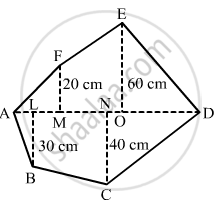
Find the area of the following polygon, if AL = 10 cm, AM = 20 cm, AN = 50 cm, AO = 60 cm and AD = 90 cm.