Advertisements
Advertisements
Question
A flooring tile has the shape of a parallelogram whose base is 24 cm and the corresponding height is 10 cm. How many such tiles are required to cover a floor of area 1080 m2?
Advertisements
Solution
Base of a flooring tile that is in the shape of a parallelogram = b = 24 cm
Corresponding height = h = 10 cm
Now, in a parallelogram:
Area(A) = Base (b) x Height (h)
\[ \therefore\text{ Area of a tile }= 24 cm \times 10 cm = 240 {cm}^2 \]
Now, observe that the area of the floor is 1080 \[m^2 . \]
\[1080 m^2 = 1080 \times 1m \times 1m\]
\[ = 1080 \times 100 cm \times 100 cm (\text{ Because }1 m = 100 cm)\]
\[ = 1080 \times 100 \times 100 \times cm \times cm\]
\[ = 10800000 {\text{ cm }}^2 \]
∴ Number of required tiles =\[ \frac{10800000}{240} = 45000\]
RELATED QUESTIONS
The diagonals of a rhombus are 7.5 cm and 12 cm. Find its area.
There is a pentagonal shaped park as shown in the figure. For finding its area Jyoti and Kavita divided it in two different ways.
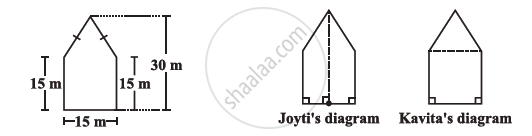
Find the area of this park using both ways. Can you suggest some other way of finding its area?
The area of a rhombus is 240 cm2 and one of the diagonal is 16 cm. Find another diagonal.
Find the area of a rhombus, each side of which measures 20 cm and one of whose diagonals is 24 cm.
In exchange of a square plot one of whose sides is 84 m, a man wants to buy a rectangular plot 144 m long and of the same area as of the square plot. Find the width of the rectangular plot.
The area of a rhombus is 84 m2. If its perimeter is 40 m, then find its altitude.
A field in the form of a rhombus has each side of length 64 m and altitude 16 m. What is the side of a square field which has the same area as that of a rhombus?
The area of a rhombus is equal to the area of a triangle whose base and the corresponding altitude are 24.8 cm and 16.5 cm respectively. If one of the diagonals of the rhombus is 22 cm, find the length of the other diagonal.
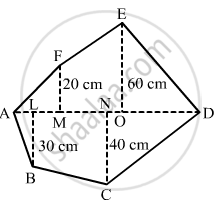
Find the area of the following polygon, if AL = 10 cm, AM = 20 cm, AN = 50 cm, AO = 60 cm and AD = 90 cm.