English

Fill in the Empty Bubbles in Column C with Reports of What Was Said in Column A, as in the Box Given Above. - English - Communicative

Advertisements
Advertisements

Question

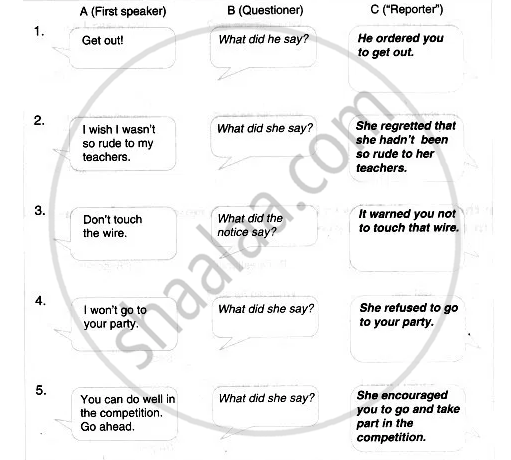
Fill in the empty bubbles in Column C with reports of what was said in Column A, as in the box given above.

Answer in Brief
Fill in the Blanks
Advertisements

Solution

Answer:
A (first speaker)
B (Questions)
C (”Reporter”)
shaalaa.com
Writing and Grammar
  Is there an error in this question or solution?
Chapter 7.1: Reported Speech - Exercises [Page 92]

APPEARS IN

CBSE English Communicative Workbook Interact in English [English] Class 9
Chapter 7.1 Reported Speech
Exercises | Q 3 | Page 92

RELATED QUESTIONS

Answer the following question briefly:
(a) What is a ‘nickname’ ? Can you suggest another one for Private Quelch?


Answer the following question briefly:

Do you think Private Quelch learnt a lesson when he was chosen for cookhouse duties?


Working in groups of four, write the article on the following :
The elderly seek attention and company from younger members of their family. They are eager to listen and long to share their life experiences. John A Pescud is not only respectful but also very patient with Colonel Allyn, Jessie’s father. As a reporter, write an article for a newspaper, on the importance of the elderly in our lives.


Answer the following questions:

Bicker’ means ‘to quarrel’. Why does the poet use this word here?


Answer the following questions:

Where does it finally meet the river?


Answer the following question.

The Poem invokes beautiful imagery which is built around 'sigh of the sea', 'laughter of
the field' and 'tears of heaven'. Explain the three expressions in the context of rain.


Answer the following question briefly.

Why is Gaston not interested in buying the villa in the beginning?


Imagine that a Social Worker comes to the abandoned farmhouse to find out what may have happened to the family. She makes the following observations in her note-pad 

Clues Conclusions
empty house  Have they left? Where could they have gone to? 
boulders in the field , leaky barn The owner might not have been a farmer. 
 sealed jars in the cellar  A woman lived there - family short of money left in a hurry 
toys scattered in the yard Something went wrong????? 

On the basis of these notes, the Social Worker presents the facts as she sees them to her Head of Department. Unfortunately, she spills ink on her report. Complete her report. 

When I reached the farmhouse , I saw that the house was empty , which ........ I wondered where they might have gone . .................. the owner was not a farmer , because of the boulders in the field and the leaky barn .............. the family was poor , because I saw several sealed jars in the cellar . Also ............ a woman lived there .  It was obvious she had left in a hurry . what was most touching was that the toys were scattered in the yard . 


You are a member or 'Explorer', an adventure club. Write a paragraph about one of your experiences or adventure activity.
Here are some words and phrases you can use 

Curious  thrilled  terrified  relieved 
felt euphoric  agonizing moments  insecurity  grateful 
uncertainty  overwhelming experience  extraordinary  courage 

Why do you use the determiners? Match the determiners with their uses, using the clues given below:

  1. their; his; her; your;____  _________
  2. a few; a little; some;____  _________
  3. any ____  _________
  4. this; these; other___  _________
  5. two____  _________


Simple Present and Present Continuous
Mr. Madan is going on tour next week. Look at his itinerary.

Mr. Madan Tour of North India and Nepal
Mon 7th Mumbai 06:30 Peace
Conference
Delhi 08:30
Tues 8th Delhi 07:30 Cultural
Centre
Agra 10:30
Wed 9th Agra 09:30 Local
School Head Teacher

Varanasi

13:30

Thurs 10th Varanasi 08:00
Discuss Trade
Unions
Patna 18:30
Fri 11th Patna 14:00
Himalayan Project

Kathmandu

17:00

Sat 12th Kathmandu 11:00 Delhi 14:00

Describe Mr. Madan’s schedule for next week. Use verbs from the table below.


Make five promises to your friend expressing your willingness to do something.
Use shall/will
e.g. I shall never be late to school.

Promises to Keep!

Did you Know?
One of the puzzling things in English is to know when to use shall and when to use will.

Whenever we desire to express some command, promise, threat or determination shall is used in the second and third person and will is used in the first person.

You shall receive your prize tomorrow, (promise)
He shall not enter the lab again, (determination)
I will reward her for her diligence, (promise)
I will report to the Principal if you don’t submit your homework, (threat)
I will never use abusive language, (determination)

Rearrange the following words and phrases to form meaningful sentences. The first one is done for you as an example. Write the answers in your answer sheet.

are / the / dreams scenarios/picture perfect houses/not a speck of dust/and no cobwebs ever/with a wrinkle-free bedcover/on the shelves
Picture perfect houses with a wrinkle-free bedcover, not a speck of dust on the shelves and no cobwebs ever are the dream scenarios.

(a) of its residents/becomes a/it reflects/a house/the personality/home when
(a) _______________________________________

(b) has to look/no rules/how our/there are/as to/home
(b) _______________________________________

(c) thing is/ inhabiting them/should enjoy/the important/that we
(c) _______________________________________

(d) about/houses are/our lives/personal statements
(d) _______________________________________

(e) the confidence/in ourselves/they reflect/we have
(e) _______________________________________

(f) we have/will be/the more/ individualistic/confidence/the more/our homes 00
(f) _______________________________________


Use the information in the headlines to complete the sentences. Choose the correct option from those given.

(a) Women Rescue Child
Two brave women of Rampur village ____________ kidnapped by his father’s distant relative.

  1. have rescued a child who has been
  2. have rescued a child who was being
  3. rescued a child who had been
  4. rescued a child who was

(b) Two killed in Collision
Two passengers travelling in a car died ____________. The driver of the truck is absconding.

  1. after their collision of a truck
  2. in a collision with a truck
  3. after their car collided in a truck
  4. when their car collided with a truck

(c) Ban on Smoking
Smoking ____________ in all public places.

  1. has been banned
  2. is being banned
  3. banned
  4. was banned

(d) Old Building Demolished
Keeping in mind the dilapidated condition of ____________ yesterday.

  1. the building, it was demolish
  2. the building, it was demolished
  3. the building, it has been demolished
  4. the building, it will be

Fill in the table to identify the subject, verb and object in the sentences listed above. You may include the object/agent where necessary.

Subject Verb Object
Kareena’s
hometown
had not been
invaded
(by) the marvels
of technology.
Industries ___________
Was not polluted
__________
__________
Stories __________ __________

Did you know?
A passive construction does two things.
(i) it brings the object to the position of the subject.
(ii) it introduces the verb be and the past participle form of the verb. (-ed/ -en)
A passive construction is be used when
(a) the agent is unknown
e.g. Gold jewellery worth one crore was found missing.
(b) the agent is too obvious
e.g. The speeding car was stopped at the signal for violating the traffic rules.
(c) the process is more important than the doer.
e.g. Vanilla flavour is added to the milkshake.
(d) the speaker wants to hide the source for confidentiality.
e.g. I was informed that the staff accept gifts from the customers.


Now prepare a graph based on the students' response to the survey you conducted in Question 2. Then write a report for the newspaper taking the help of Question 5, Question 3 and Question 6. You may follow this pattern: 

Paragraph 1 : A suitable introduction as in B.4. 
Paragraph 2 : Hours per week spent on different activities - classes VI, IX and XI compared. 
Paragraph 3 : How extra time would be used - Classes VI, IX and XI compared. 
Paragraph 4 : Boys and girls compared - Classes VI, IX and XI 
The following words and phrases will be useful to you: 

To express proportion 
Most __
Many __ 
The majority of ___ 
A large number of ___ 
A small number of ___
Very few ____
Only a few ___ 
To express frequency 
Most of the time ___ 
Frequently ___
Occasionally ___ 
Often ____
At times ___ 
To express comparison and contrast 
__ compared with __
On the other hand, ___ 
In contrast, ___ 
By comparison, ___
___ however, ___
____ in comparison with ___ 
You may also find some of the phrases from B.5 useful. 


In pairs, choose one topic from the table in Question 3. Imagine that you and your parents are expressing your views on the topic. Use your notes from the table and write the dialogue that would take place. Make it funny! Share your dialogue with the rest of the class. 


Read the following sentences. Each sentence has four words underlined. Select one underlined word that is incorrect and write it in the space provided. The first one has been done as an example:

1. The statue of liberty is designed by Fedreric Auguste Barthold.

is

2. Is was completely in france in july 1884. 


3. The statue was shipped to New York with 350 pieces.


4. She arrieved there on 17 june 1885.


5. The pieces were put together but the opening ceremony took place on 28 Oct 1886.


Given below is some information about Jesse Owens, one of the most famous athletes of all times. His friend is planning to write his biography. Using information from the table, complete the biography. (The first gap has been completed for you, as an example.) 

James Cleveland Owens (J.C. Owens) became famous as Jesse Owens 

1913 Birth, Alabama, USA. 
1934 After First World War - goes to school, teachers recognise and develop his athletic talents. 
1935 Six world records 
1936 Berlin Olympics, four gold medals 
1950 Sports experts vote him Greatest Track Athlete of the half Century. 
1960 Another athlete breaks Owens' last Olympic record .
1980 Dies oflung cancer. 

Jesse Owens was born in Alabama USA, in 1913. He was the youngest often children, and the family lived in a cramped shanty house. After the First World War, the family moved to Cleveland, where his school (1)__________ his talents. He quickly became a local hero. Soon afterwards he gained a place not only at the Ohio State University, but also in the US Olympics team. 
On 25th May 1935, Jesse Owens performed athletics' greatest feat when he (2) _________ at the Ohio state University Athletics Championships. A year later, at the Berlin Olympics, his greatness was confirmed; he (3) __________ for 100m, 200m, long jump and sprint relay. 
Because of his achievements in track and field events, in 1950 he (4) _______ .His last Olympic record (5) ___________ only in 1960. This great athlete (6) ______________ 1980. 


Think of a person in your class, and use adjective + prepositions to describe him/her in about two or three sentences. Don't give a name.

(a) e.g. She’s good at Maths.
She’s keen on hiking.

Show your description to your partner. Let her or him guess who it is.
(b) The following diagram explains the use of some of these prepositions.

Destination Position Destination Position Reference
to •X at •X away from x ⇒

away from x •

Referring to a
on (to) on off off Referring to a
line or surface.
into in out of out of Referring to an
enclosed area

Notice the following peculiarities in the use of Prepositions.
1) at relates to a small extent of space or time while in relates to a wider extent.
2) with relates to the instrument used for doing something.
by relates to the doer
e.g. (1) This poem was composed~me
(2) I wrote with a Shaffer's pen.
3) between, among: between is used when there are two things or persons or
ideas, among is used for more than two.
e.g. ( 1) The property was divided between the twins.
(2) The gossip spread among the villagers.
4) beside, besides : beside means by the side of, besides means in addition to
e.g. (1) Ram sat beside his grandmother.
(2) Besides music, he is interested in painting.
5) in and within : in denotes at the close of some future period, within denotes
sometime short of the close
e.g. (1) The project will be implemented in a week's time.(= at the close)
(2) The plan will be sanctioned within a fort night(= less than)


Share
Notifications

Englishहिंदीमराठी


      Forgot password?
Use app×