Advertisements
Advertisements
प्रश्न
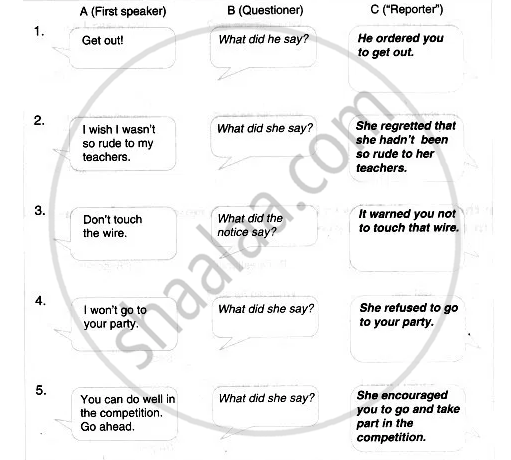
Fill in the empty bubbles in Column C with reports of what was said in Column A, as in the box given above.

Advertisements
उत्तर
Answer:
A (first speaker)
B (Questions)
C (”Reporter”)
APPEARS IN
संबंधित प्रश्न
Here are some direct quotations from the story. Identify the speaker and write what each quotation suggests about the speaker. You can use the adjectives given in the box and may also add your own.
| amiable, tender, gentle, sympathetic, understanding, determined, diligent, kind, concerned, systematic, wise, helpful, enthusiastic, selfish, cruel, humble, religious, prudent |
| Speaker | Quotation | Quality Highlighted | |
|
a. |
'Avva, is everything all right? Are you O.K.?' |
||
| b. | 'At times, I used to regret not going to school, so I made sure that my children and grandchildren studied well.' |
||
| c. | 'Avva, don't cry. What is the matter? Can I help you in anyway?' |
||
| d. | 'We are well-off, but what use is money when I cannot be independent.' | ||
| e. | 'I will keep Saraswati Pooja day during Dassara as the deadline.' | ||
| f. | 'For a good cause if you are determined you can overcome any obstacle.' | ||
| g. | I am touching the feet of a teacher not my granddaughter.' |
Answer the following question briefly:
How did Private Quelch manage to anger the Corporal?
Answer the following questions:
‘I make the netted sunbeam dance’. What does ‘the netted sunbeam’ mean? How does it dance?
The brook appears to be a symbol for life. Pick out examples of parallelism
between life and the brook from the poem.
On the basis of your understanding of the poem, answer the following question
by ticking the correct choice.
The seven roles that a man plays correspond to his __
The poet draws conclusions about the family without having met them. He does this in lines such as :
Something went wrong, says the empty house
in the weed-choked yard ...
This is a style of English that is very suitable for a poem. But in ordinary speech or writing we use expressions such as :
|
So it is Therefore it is |
probable likely possible |
that |
| It |
seems appears |
that....... | because..... |
| This suggests that ... |
For example, we could say :
• There are large shoes in the farmhouse. So it is likely that the farmer was a big man.
• It seems that they had a child, because there is a sandbox made from a tractor tyre.
• The kitchen shelves were covered with oil cloth. This suggests that a woman lived in the farmhouse.
Make other sentences like this, using ideas from the poem.
Answer the following question briefly.
Who is better business person - Juliette or Gaston? substantiate your view with
examples from the text.
The next part of the story has been given below. Punctuate it, remember to use quotation marks (" ")when people speak.
they were dressed strangely in eccentric clothing shorts shirts and different garments they carried in their hands their bodies from throat to ankle were hidden by black cloaks the boy who controlled them came forward vaulted on to the platform with his cloak flying and peered into what was almost complete darkness whereas the man with the trumpet ralph sensing his sun blindness answered him theres no man with a trumpet only me the boy came close and peered down at ralph screwing up his face as he did so he turned quickly isnt there a ship then he was tall thin and bony his face was crumpled and freckled out of his face stared two light blue eyes frustrated now and turning or ready to turn to anger isnt there a man here ralph spoke to his back no we are having a meeting come and join us
Now try to build your own similes for the following :
- The rock stood…
- The waves leapt…
- The sea shone …
- The sun set…
- The rain fell heavily …
- The birds soared …
- Dawn broke …
- The stars…
- The wind shook the trees …
Add other similes of your own and write them in your notebook.
Study the given notes and complete the paragraph that follows by filling in the blanks.
Mobile phones — emit electromagneticfield — prolonged exposure — researchneeded — brain illness — cancer memoryloss — evidence — likely to cause — healthscares — press reports — people worryneedlessly.
Think about it. Every time you use a mobile phone, (a)_____________ head to electromagnetic emission. Manufacturers (b)___________to prove there is no risk (c)_____________ . Some evidence, so far suggests that mobile phone emissions (d)_________ . These health scares (e)______ . So, people worry needlessly.
(a) (i) he exposes his
(ii) one exposes his
(iii) one exposes one’s
(b) (i) needed
(ii) are needed
(iii) have needed
(iv) need
(c) (i) in brain cancer or memory loss
(ii) from brain cancer or memory loss
(iii) with brain cancer or memory loss
(iv) of brain cancer or memory loss
(d) (i) are likely to cause illness
(ii) are likely for causing illness
(iii) is likely in causing illness
(v) is likely to cause illness
(e) (i) is base on press reports
(ii) have been based on press reports
(iii) are based on press reports
(iv) are being based on press reports
Edit the following narrative by choosing the appropriate word from the options given at the end of the paragraph.
(a) Wander along the streets of New York City, my daughters and (b) me stop at shoe stores wherever we (c) happens to be. This is their choice. These women, who as little (d) girl, teetered around the house (e) balances like cranes in my mother’s high heels. I (f) sits on the bench and wait while they try on shoe (g) on shoe readjusting their positions in (h) a mirror, eyes downcast considering their feet.
“So?” one of them (i) will ask me. “What do you think of these?” “I love them,” I say about (j) all pairs.
| (a) (i) wandered (ii) wandering (iii) were wandering (iv) was wandering |
| (b) (i) they (ii) I (iii) we (iv) us |
| (c) (i) happen (ii) happened (iii) are happening (iv) are happened |
| (d) (i) girls (ii) woman (iii) boys (iv) people |
| (e) (i) are balancing (ii) is balancing (iii) balanced (iv) balance |
| (f) (i) sit (ii) am sitting (iii) sat (iv) was sitting |
| (g) (i) after (ii) before (iii) in (iv) by |
| (h) (i) that (ii) the (iii) their (iv) x |
| (i) (i) is asking (ii) asks (iii) are asking (iv) asked |
| (j) (i) every (ii) few (iii) some (iv) a |
(a) Answer the following questions:
- Where were the characters at the time of narration?
- Who was travelling with the aunt?
- How did the children pass their time?
- How long would they take to reach Templecombe?
- How does the aunt respond to the children’s antics? Why do you say so?
(b) You must have used a variety of articles in your answer. Why did you use them? Discuss the reasons with your teacher.
Study the following pair of sentences from the description. Notice the use of
articles-a, an or the or no article (X).
e.g. The next stop was at X Templecombe.
An aunt belonging to the children sat in one corner.
In the corner sat a stranger.
Hence we conclude
1. No article is used before a proper noun.
2. 'The' is used to refer to a specific place/person/ object.
3. 'A' is used when the person/place is referred to for the first time.
4. 'An' is used before a vowel sound.
Work in pain and complete the table of the supernatural theories and logical explanations as presented in 'The Mystery of Bermuda Triangle'.

List some phrases and words that come to your mind, when you look at the picture given below

Look at the following pair of sentences. Underline the modals and discuss why each one is used in that sentence.
e.g.
I must not take those pills. (I’m not allowed.)
I need not take those pills. (It is not compulsory but I may if I wish.)
(b) I needn’t go to the meeting if I don’t wish to.
2. (a) I can swim a length of the pool.
(b) I can swim in the pool on Saturdays.
3. (a) You ought to get a nice present for her.
(b) You have to get a nice present for her.
4. (a) Can I go to the toilet?
(b) May I be excused?
5. (a) I may come tomorrow if I have the time.
(b) I might come tomorrow but it’s going to be difficult.
Did you know?
Modals are a small group of verbs that are used to express possibility,
probability, capability, capacity, ability, obligation and predictions.
Some of the modals you learnt in this unit are
can
may
shall
could
might
should
Need, dare, had better are also modals.
Understanding Modals:
Modal Auxiliaries
A modal verb or auxiliary verb is a verb, which modifies another verb, so that
the modified verb has more intention in its expression. In essence the modal
verb expresses modality, the way in which something is being said.
The main modals are
Can: could; may: might; shall: should; will: would: must; ought to; need to;
have to.
The negative modals are
Couldn't; wouldn't; shouldn't; mustn't; needn't; oughtn't/ ought not to
| Modal | Examples | Uses |
| Can/ can't |
She can read and write It can rain today Can I borrow your pen? Can you lend me your notes? Can I carry your books? |
ability possibility /probability seeking permission request offer |
| Could/ couldn't |
Could I borrow your book? Could you please help me with this sum? We could go for a picnic on Sunday I think you could come first this time There was a time when I could work round the clock. |
seeking permission request suggestion possibility/ probability past ability |
| May |
May I have some water? May I help you? May I shut the door? India may become a super power by 2020. May God bless you |
request offer permission possibility/ probability wish/ desire |
| Might | They might sell their house as they need the money. | future possibility/ probability |
| Will /Won't |
It is very cold so I will stay at home. I will help you if you wish. Will you look after my dog for a day? It will rain tonight. I will get you a shawl from Srinagar. |
intention offer request prediction promise |
| Would/Wouldn't |
Would you mind if I come over tonight? Would five o'clock suit you? Yes it would. Would you pass the salt? Would you come to my party? Would you prefer tea or coffee? |
permission making arrangements request invitation preference
|
| Shall |
Shall I help you? Shall we meet at 3.00 pm outside Bakshi Stadium? |
offer making arrangements |
| Should |
We should check the timings of the train. You should listen to the advice of your elders. |
recommended action advice |
| Ought to |
You ought to do your duty. The bus ought to be here any minute |
advice probability |
| Must/mustn't |
We must make a move now. You mustn't tell lies. |
obligation necessity |
| Need |
He need not go to the market. You need to lose weight. I need to get the groceries. |
necessity compulsion insistence |
Film/Book Review
The aim of writing a film review is to judge a film or a book and inform the viewer / reader about it. The reviewer talks about the subject of the film / book being reviewed and how the film maker or director / author has handled the subject. At times the reviewer's aim is to arouse the interest of the viewer/ reader so that she / he wishes to see the film / read the book. Sometimes, the reviewer warns the viewer/ reader why she / he should not see or read a particular film / book.
Write a review of a Harry Potter film / book or an episode of Malgudi Days that you have seen.
You must include :
• the name of the film / book
• the cast / director/ writer
• the important characters
• a very brief outline of the film / book
• why the film/ book was worth seeing or reading / not worth seeing or reading.
Sources
1) //en.wikipedia.org/wiki/Bermuda-Triangle//
2) /www.bermuda-triangle.org/
3) /www.bermudatrianglemystery.net./
Report the following questions. (Use if/whether or why, as appropriate.)
- Have you met my sister?
She asked _________________ (use you and her) - Do you want a drink?
He asked _________________ (use you) - Why didn’t you study for the Unit test?
She asked _________________ (use he) - Can you help me with my homework this evening?
He asked _________________ (use she) - Have you had lunch yet?
They asked _________________ (use he)
Read the following sentences. Each sentence has four words underlined. Select one underlined word that is incorrect and write it in the space provided. The first one has been done as an example:
1. The statue of liberty is designed by Fedreric Auguste Barthold.
| is |
2. Is was completely in france in july 1884.
3. The statue was shipped to New York with 350 pieces.
4. She arrieved there on 17 june 1885.
5. The pieces were put together but the opening ceremony took place on 28 Oct 1886.
Look at the notes given below and complete the paragraph that follows by choosing the correct option from the choices given.
Kamala Das alias Kamala Suraiyya - famous Indian writer - published auto
biography - My story - translated - foreign languages.
Kamala Das also (a)_______________ is (b)_______________She (c)_____________ ‘My Story’ when she was 42 years old. Her autobiography (d)________________ into many foreign languages.
| (a) (i) called as Kamala Suraiyya (ii) known by Kamala Suraiyya (iii) known as Kamala Suraiyya (iv) said as Kamala Suraiyya |
(b) (i) famous Indian writer (ii) a famous Indian writer (iii) the famous Indian writer (iv) famous as an Indian writer |
| (c) (i) published her autobiography titled (ii) published an autobiography titled (iii) published an autobiography as (iv) published an autobiography as |
(d) (i) is being translated (ii) will be translated (iii) have been translated (iv) has been translated |
