Simple Past and Past Perfect
Complete this story by Julius Lester. Choose the correct forms of the words
given in the brackets.
Brer Rabbit (a) ________ (decidedI had decided) gardening was too much hard work. So he (b) ________ (had gone/went) back to his old ways of eating from everybody else’s garden. Earlier, he (c)________ (made/had made) a tour through the community to see what everybody (d)________ (had been/was) planting that summer and his eye (e) ________ (was/had been) caught by Brer Fox’s peanut patch.
Soon as the peanuts (f) ________ (had been/were) ready, Brer Rabbit (g) ________ (decided/had decided) to make his acquaintance with them. Every night he (h) ________ (had eaten/ate) his fill and even started bringing his family. Brer Fox (i) _______ (had/had had) a good idea who was eating his peanuts, but he couldn’t catch him. He inspected his fence and finally (j) ________ (had found/found) a small hole on the north side. He tied a rope with a loop knot and put it inside the hole. If anybody (k) ________ (stepped/had stepped) in it, the rope would grab his leg and hoist him up in the air.
That night Brer Rabbit (l) _______ (came/had come) down to the peanut patch. He climbed through the hole and WHOOSH ! Next thing he (m) _______ (had known/knew), he was hanging in the air upside down. There (n) ________ (wasn’t/hadn’t been) a thing he could do, so he made himself comfortable to catch a little sleep!
Answer the following questions based on the story you have read.
(a) What had Brer Rabbit found out?
(b) What did he do when the plants grew?
(c) How did he enter Brer Fox's peanut patch?
(d) Brer Fox had an idea of who was stealing from his patch. What did he do to trap
Brer Rabbit?
You must have used the simple past tense and past perfect tense in your
answer. Do you know most often, when you use the past perfect, you use it with
the (simple) past?
Study the sentences from the story and write whether (a) the action happened
before the action mentioned in the simple past tense, or (b) an action happened
after the action mentioned in the past perfect tense.
(e.g.) Brer Rabbit had decided _(a)_ gardening was _(b)_too much for him. So,
he went __ back to his old ways. Earlier, he had made __ a tour through
the community to see what everybody had been __ planting that summer
and his eye was __ caught by Brer Fox's peanut patch.
| thought |
emotion |
possession |
perception (often used with can) |
measurement |
| |
|
|
|
|
| |
|
|
|
|
| |
|
|
|
|
| |
|
|
|
|
| |
|
|
|
|
Some verbs, like the ones mentioned above, are not normally used in the continuous (- ing) form. However, we do sometimes use such verbs in the continuous form. Look at the following examples.
1. “I can’t concentrate on my work because I’m thinking about that beautiful scene.”
2. “I think it is beautiful.”
- Which sentence expresses an activity in progress at the moment?
- Which sentence expresses a decided opinion?
Read the following excerpts from newspapers on various environmental issues.
Ban the Bag
The Indus Valley Civilisation left beautifullycrafted pottery that speaks volumes of the advances its people made. After 3,000 years, if the ruins we leave behind are excavated, chances are only plastic bags would be dug up. It may sound like an exaggeration, but these bags are not biodegradable. Apart from causing emissions when these are manufactured, noxious fumes are released while these are being burnt or disposed off. So, be kind to Mother Earth the next time you go shopping for groceries, remember to carry a cloth bag with you.

What India Should Do
India has released the National Action Plan on Climate Change. Is it adequate? Is there more that the country can do? Here are some ways how we can make a difference.
(a) SOLAR MISSION
1) To promote the use of solar energy through solar photovoltaic and thermal systems for power generation .
2) To integrate other renewable energy technologies like biomass and wind.

(b) ENERGY EFFICIENCY
1) To mitigate GHG through sector-specific and cross-cutting technology and fuel switch options.
2) To use more LNG and biomass fuels besides seeking tech transfer.

(c) SUSTAINABLE HABITAT
1) To promote energy efficiency in the residential and commercial sectors through LPG use.
2) To manage municipal solid waste and urban public transport in a better way.

(d) WATER MISSION
1) To promote efficient water use, augment supply in critical areas and ensure effective management of water resources.
2) To have better management of surface and groundwater,and conserve wetlands.

(e) SUSTAINING HIMALAYAS
1) To enhance monitoring and conservation of the Himalayan ecosystems, empower local communities for management of ecological resources and promote sustainable tourism.

(f) GREEN INDIA
1) To reduce fragmentation of forests, enhance public and private investments for plantation, upscale joint forestry management and promote conservation of biodiversity. Need to afforest degraded lands.

(g) SUSTAINABLE AGRICULTURE :
1) To focus on four crucial areas - dry land agriculture, risk management, access to information and promoting the use of biotechnology.
2) To develop drought and pest resistant varieties.

First, you will hear a local radio programme, read out by teacher / student which is given below which will give you ideas for your own programme. First, listen without writing anything.
Presenter 1: A very good day to all our listeners. This is your local radio station, Class IX Local Radio - bringing you up-to-the - minute news, current affairs, music, interviews, round-ups - and much much more.
Presenter2: Yes, and in today's programme we have a special report from Ketaki Lahiri on "Safety at School".
Presenter 1: Nikhil Gomes brings you his regular weekly review of "Beyond the Timetable",
Presenter 2: And Leena invites you to "Meet the Teacher".
Presenter 1: And lots more - jokes, news -you name it and we have it. We start with the round-up of School News by our roving correspondent - Anant Singh. Anant, over to you.
Anant: Good morning, everybody! The highlight of this weeks' School News is that our school football team lost every single match it played in the YMCA football tournament at league level. The physical education teacher is so livid that he has threatened to make the school team practice on a doubletime schedule from tomorrow. So, friends, it's "wake-up" at 4 a.m for all footballers henceforth.
In another school news, the tiny tots were taken on a visit to the zoo. Some, it is said, did not wish to return. One accompanying teacher, we are told, had a tough time convincing them that life outside is better!
Class XII put on a one-act play "Examination Fever" which was written, directed and produced by them. The proceeds from this show are being sent to "Prathyasha" - an organisation that helps handicapped children.
Look out next week for new faces around the school. A group of 20 students from Japan are arriving on a cultural exchange programme, We might even get one of them on our next edition ofThe Class IX Radio Show!
Presenter 1: So ... Lots happening at school, it seems,-and lots more on your Local Radio. It's time for jokes now. Over to you, Hafeez and Aarohi.
Aarohi: Waiter , Waiter , what's wrong with these eggs ?
Hafeez: I don't know. I only laid the table;
Aarohi: Waiter, waiter, what's this fly doing in my soup?
Hafeez: Breaststroke, I think, Sir,
Teacher: I wish-you would pay a little more attention.
Pupil: I'm paying as little as I can.
Teacher: You should have been here at 9 o'clock.
Pupil: Why, what happened?
Presenter 2: Thank you, Hafeez and Aarohi. And don't forget, listeners, to send in your jokes. Every original joke will win you a reward of RslO/- for each one played on your favourite radio programme - Class IX Local Radio - the station just for you.
Presenter 1 : And now to your regular spot "Meet the Teacher", in which Leena interviews one of your favourite teachers to discover the real person "behind the chalk dust".
So it's all yours, Leena.
Leena: Thank you ! I'm delighted today to be able to interview the Head of the Science Department, Mr Chirag Sharma. Mr Sharma, what all our listeners are dying to know is - are you as strict at home as you are at school?
Mr Sharma: (Laughs heartily). I don't have a bunch of forty naughty children at home.
Leena: Did you ever get into trouble when you were at school?
Mr Sharma : Have you ever thought about how I am able to catch you in your tricks? I was usually up to the same tricks at school! No, I'm afraid my teachers were not very happy with me.
Leena: How good were you in your studies, Sir?
Mr Sharma: Ah, that was my strong point. My work was always up-to-date and fairly good. I was naughty, but I was also keen to learn more.
Leena: How do you spend your evenings and holidays, Sir?
Mr Sharma: I like to spend time at home with my teenage children. We have common tastes in music.
Leena: Any message for our listeners Sir?
Mr Sharma: Yes. Fun and-play have their place in our lives. We must enjoy our play. At the same time, we must work with enthusiasm and sincerity.
Leena: Thank you, sir !
Presenter 2 : Thank you Leena for that fascinating interview. I'm sure we all know, now what makes Mr Sharma 1tick1• And now it's time for a break. It's "advert time".
"Buy two but pay for one!"
Ruchita of VIIC has a fabulous offer. Two pencil boxes for the price of one. Pay Rs 5 / for the bargain.
Lost - A Keltron calculator. Krishna of Class XIIA has offered a treat in the school canteen to the finder.
Presenter 1: And now, a very serious subject. Ketaki has been researching the topic 'Safety at School'. She has come up with some very disturbing findings. This is the report. Ketaki?
Ketaki: As I went around the senior school I was alarmed to find a number of broken electric sockets with exposed wires. Beware of this hidden danger, senior students. That brings me to another danger - this time in the primary block. The lid of the ground level water tank is broken. Till it is repaired, students are warned not to go anywhere near it.
Presenter 2 : Well, time1s up boys and girls of Class IX Local Radio - bringing you news and entertainment of interest to you, in your school and locality. Until next week ...
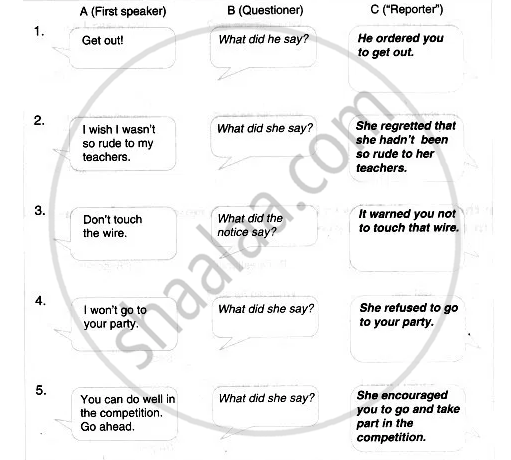
Reported speech in Extended practice.
Read the dialogue between Mr Coomer (Mr C), the British Scholarship Officer, and an applicant, Miss Reena Banerjee (R).
Mr C : Come in, Miss Banerjee.
R : Thank you.
Mr C : Please sit down. Can I get you a cup of coffee or a cold drink?
R : Yes thank you. A cold drink, please.
Mr C : I’m just going to ask you a few questions. How long have you been studying English?
R : I’ve had private as well as school lessons for 14 years.
Mr C : Just as background information, what do you do in your spare time?
R : I’ve always enjoyed drama, and also debating.
Mr C : Why do you wish to obtain a scholarship to study in Britain?
R : Well, I’m interested in studying Immigration Law, and there are several good colleges in Britain dealing with his.
Mr C : Very interesting. Finally, do you know that the grant only covers teaching fees?
What about your living expenses?
R : My sister will pay for my personal expenses.
Mr C : Well, Miss Banerjee, we’ll be writing to you next week. Thank you for coming.
Reena meets her friend, Latha, after the interview. She is very excited and tells Latha exactly what happened. Fill in the spaces using reported speech.
Fill in the [boxes] with reporting verbs.