Advertisements
Advertisements
Question
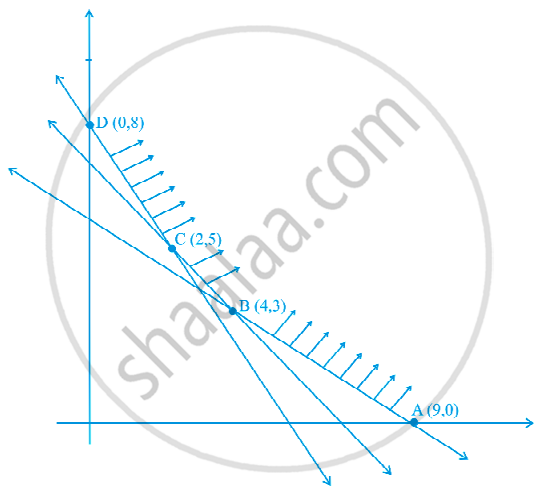
Feasible region (shaded) for a LPP is shown in the Figure Minimum of Z = 4x + 3y occurs at the point ______.
Options
(0, 8)
(2, 5)
(4, 3)
(9, 0)
Advertisements
Solution
Feasible region (shaded) for a LPP is shown in the Figure Minimum of Z = 4x + 3y occurs at the point (2, 5).
Explanation:
APPEARS IN
RELATED QUESTIONS
A firm manufactures two types of products A and B and sells them at a profit of Rs 2 on type A and Rs 3 on type B. Each product is processed on two machines M1 and M2. Type A requires one minute of processing time on M1 and two minutes of M2; type B requires one minute on M1 and one minute on M2. The machine M1 is available for not more than 6 hours 40 minutes while machine M2 is available for 10 hours during any working day. Formulate the problem as a LPP.
A rubber company is engaged in producing three types of tyres A, B and C. Each type requires processing in two plants, Plant I and Plant II. The capacities of the two plants, in number of tyres per day, are as follows:
| Plant | A | B | C |
| I | 50 | 100 | 100 |
| II | 60 | 60 | 200 |
The monthly demand for tyre A, B and C is 2500, 3000 and 7000 respectively. If plant I costs Rs 2500 per day, and plant II costs Rs 3500 per day to operate, how many days should each be run per month to minimize cost while meeting the demand? Formulate the problem as LPP.
A manufacturer can produce two products, A and B, during a given time period. Each of these products requires four different manufacturing operations: grinding, turning, assembling and testing. The manufacturing requirements in hours per unit of products A and B are given below.
| A | B | |
| Grinding | 1 | 2 |
| Turning | 3 | 1 |
| Assembling | 6 | 3 |
| Testing | 5 | 4 |
The available capacities of these operations in hours for the given time period are: grinding 30; turning 60, assembling 200; testing 200. The contribution to profit is Rs 20 for each unit of A and Rs 30 for each unit of B. The firm can sell all that it produces at the prevailing market price. Determine the optimum amount of A and B to produce during the given time period. Formulate this as a LPP.
An automobile manufacturer makes automobiles and trucks in a factory that is divided into two shops. Shop A, which performs the basic assembly operation, must work 5 man-days on each truck but only 2 man-days on each automobile. Shop B, which performs finishing operations, must work 3 man-days for each automobile or truck that it produces. Because of men and machine limitations, shop A has 180 man-days per week available while shop B has 135 man-days per week. If the manufacturer makes a profit of Rs 30000 on each truck and Rs 2000 on each automobile, how many of each should he produce to maximize his profit? Formulate this as a LPP.
A firm manufactures two products, each of which must be processed through two departments, 1 and 2. The hourly requirements per unit for each product in each department, the weekly capacities in each department, selling price per unit, labour cost per unit, and raw material cost per unit are summarized as follows:
| Product A | Product B | Weekly capacity | |
| Department 1 | 3 | 2 | 130 |
| Department 2 | 4 | 6 | 260 |
| Selling price per unit | Rs 25 | Rs 30 | |
| Labour cost per unit | Rs 16 | Rs 20 | |
| Raw material cost per unit | Rs 4 | Rs 4 |
The problem is to determine the number of units to produce each product so as to maximize total contribution to profit. Formulate this as a LPP.
A firm has to transport at least 1200 packages daily using large vans which carry 200 packages each and small vans which can take 80 packages each. The cost of engaging each large van is ₹400 and each small van is ₹200. Not more than ₹3000 is to be spent daily on the job and the number of large vans cannot exceed the number of small vans. Formulate this problem as a LPP given that the objective is to minimize cost
The solution set of the inequation 2x + y > 5 is
Objective function of a LPP is
Which of the following sets are convex?
Let X1 and X2 are optimal solutions of a LPP, then
The maximum value of Z = 4x + 2y subjected to the constraints 2x + 3y ≤ 18, x + y ≥ 10 ; x, y ≥ 0 is
The optimal value of the objective function is attained at the points
The maximum value of Z = 4x + 3y subjected to the constraints 3x + 2y ≥ 160, 5x + 2y ≥ 200, x + 2y ≥ 80; x, y ≥ 0 is
The objective function Z = 4x + 3y can be maximised subjected to the constraints 3x + 4y ≤ 24, 8x + 6y ≤ 48, x ≤ 5, y ≤ 6; x, y ≥ 0
If the constraints in a linear programming problem are changed
Feasible region is the set of points which satisfy ______.
State whether the following is True or False:
The optimum value of the objective function of LPP occurs at the centre of the feasible region.
State whether the following statement is True or False:
The half-plane represented by 3x + 4y ≥ 12 includes the point (4, 3)
A doctor prescribed 2 types of vitamin tablets, T1 and T2 for Mr. Dhawan. The tablet T1 contains 400 units of vitamin and T2 contains 250 units of vitamin. If his requirement of vitamin is at least 4000 units, then the inequation for his requirement will be ______
Ganesh owns a godown used to store electronic gadgets like refrigerator (x) and microwave (y). If the godown can accommodate at most 75 gadgets, then this can be expressed as a constraint by ______
Ms. Mohana want to invest at least ₹ 55000 in Mutual funds and fixed deposits. Mathematically this information can be written as ______
Determine the minimum value of Z = 3x + 2y (if any), if the feasible region for an LPP is shown in Figue.
Solve the following LPP graphically:
Maximise Z = 2x + 3y, subject to x + y ≤ 4, x ≥ 0, y ≥ 0
The common region determined by all the linear constraints of a LPP is called the ______ region.
A type of problems which seek to maximise (or, minimise) profit (or cost) form a general class of problems called.
Conditions under which the object function is to be maximum or minimum are called ______.
What is the correct sequential order of steps to formulate and solve a 2-variable Linear Programming Problem?
A furniture dealer invests in tables (\[x\]) and chairs (\[y\]). He has \[\text{Rs } 50,000\] to invest and storage space for at most \[60\] pieces. A table costs \[\text{Rs } 2500\] and gives a profit of \[\text{Rs } 250\], while a chair costs \[\text{Rs } 500\] and gives a profit of \[\text{Rs } 75\]. What is the objective function to maximise total profit \[Z\]?
For a furniture dealer with an investment limit of \[\text{Rs } 50,000\] and space for at most \[60\] pieces, where a table costs \[\text{Rs } 2500\] and a chair costs \[\text{Rs } 500\], which set of inequalities correctly represents the investment and storage constraints (where \[x\] is tables and \[y\] is chairs)?
