Advertisements
Advertisements
Question
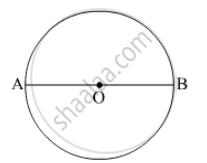
f the coordinates of one end of a diameter of a circle are (2, 3) and the coordinates of its centre are (−2, 5), then the coordinates of the other end of the diameter are
Options
(−6, 7)
(6, −7)
(6, 7)
(−6,−7)
Advertisements
Solution

Let O(−2, 5) be the centre of the given circle and A(2, 3) and B(x, y) be the end points of a diameter of the circle.
Then, O is the mid-point of AB.
Using mid-point formula, we have
Hence, the correct answer is option A.
APPEARS IN
RELATED QUESTIONS
On which axis do the following points lie?
P(5, 0)
Find the third vertex of a triangle, if two of its vertices are at (−3, 1) and (0, −2) and the centroid is at the origin.
Show that the points A (1, 0), B (5, 3), C (2, 7) and D (−2, 4) are the vertices of a parallelogram.
The line segment joining A( 2,9) and B(6,3) is a diameter of a circle with center C. Find the coordinates of C
Find the ratio in which the pint (-3, k) divide the join of A(-5, -4) and B(-2, 3),Also, find the value of k.
Find the ratio in which the point (-1, y) lying on the line segment joining points A(-3, 10) and (6, -8) divides it. Also, find the value of y.
If the point A(0,2) is equidistant from the points B(3,p) and C(p, 5), find p.
If the vertices of a triangle are (1, −3), (4, p) and (−9, 7) and its area is 15 sq. units, find the value(s) of p.
Write the coordinates of the point dividing line segment joining points (2, 3) and (3, 4) internally in the ratio 1 : 5.
If the centroid of the triangle formed by points P (a, b), Q(b, c) and R (c, a) is at the origin, what is the value of a + b + c?
Write the formula for the area of the triangle having its vertices at (x1, y1), (x2, y2) and (x3, y3).
What is the distance between the points A (c, 0) and B (0, −c)?
If the points A (1,2) , O (0,0) and C (a,b) are collinear , then find a : b.
If the points P (x, y) is equidistant from A (5, 1) and B (−1, 5), then
Point P(– 4, 2) lies on the line segment joining the points A(– 4, 6) and B(– 4, – 6).
If the coordinates of the two points are P(–2, 3) and Q(–3, 5), then (abscissa of P) – (abscissa of Q) is ______.
The coordinates of a point whose ordinate is `-1/2` and abscissa is 1 are `-1/2, 1`.
Assertion (A): The ratio in which the line segment joining (2, -3) and (5, 6) internally divided by x-axis is 1:2.
Reason (R): as formula for the internal division is `((mx_2 + nx_1)/(m + n) , (my_2 + ny_1)/(m + n))`
If the vertices of a parallelogram PQRS taken in order are P(3, 4), Q(–2, 3) and R(–3, –2), then the coordinates of its fourth vertex S are ______.
Assertion (A): The point (0, 4) lies on y-axis.
Reason (R): The x-coordinate of a point on y-axis is zero.