Advertisements
Advertisements
Question
Point (–3, 5) lies in the ______.
Options
first quadrant
second quadrant
third quadrant
fourth quadrant
Advertisements
Solution
Point (–3, 5) lies in the second quadrant.
Explanation:
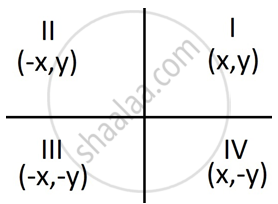
(–3, 5) is of the form (–x, y).
APPEARS IN
RELATED QUESTIONS
(Street Plan): A city has two main roads which cross each other at the centre of the city. These two roads are along the North-South direction and East-West direction.
All the other streets of the city run parallel to these roads and are 200 m apart. There are 5 streets in each direction. Using 1cm = 200 m, draw a model of the city on your notebook. Represent the roads/streets by single lines.
There are many cross- streets in your model. A particular cross-street is made by two streets, one running in the North - South direction and another in the East - West direction. Each cross street is referred to in the following manner : If the 2nd street running in the North - South direction and 5th in the East - West direction meet at some crossing, then we will call this cross-street (2, 5). Using this convention, find:
- how many cross - streets can be referred to as (4, 3).
- how many cross - streets can be referred to as (3, 4).
Let ABCD be a square of side 2a. Find the coordinates of the vertices of this square when The centre of the square is at the origin and coordinate axes are parallel to the sides AB and AD respectively.
Show that the points A(–3, 2), B(–5, –5), C(2, –3) and D(4, 4) are the vertices of a rhombus. Find the area of this rhombus.
HINT: Area of a rhombus = `1/2` × (product of its diagonals).
Determine the ratio in which the straight line x - y - 2 = 0 divides the line segment
joining (3, -1) and (8, 9).
Find the coordinates of the points which divide the line segment joining the points (-4, 0) and (0, 6) in four equal parts.
Write the distance between the points A (10 cos θ, 0) and B (0, 10 sin θ).
If P (2, p) is the mid-point of the line segment joining the points A (6, −5) and B (−2, 11). find the value of p.
If the points (k, 2k), (3k, 3k) and (3, 1) are collinear, then k
If (−2, 1) is the centroid of the triangle having its vertices at (x , 0) (5, −2), (−8, y), then x, y satisfy the relation
Point (–10, 0) lies ______.
