Advertisements
Advertisements
Question
Explain the term Plastoquinone.
Advertisements
Solution
Plastoquinone: A small molecule involved in electron and proton transfer in photosynthesis.
RELATED QUESTIONS
the exact location of the Thylakoids
The figure given below represents an experimental setup with a weighing machine to demonstrate a particular process in plants. The experimental setup was placed in bright sunlight. Study the diagram and answer the following questions:

(i) Name the process intended for study.
(ii) Define the above mentioned process.
(iii) When the weight of the test tube (A & B) is taken before and after the experiment, what is observed? Give reasons to justify your observation in A & B.
(iv) What is the purpose of keeping the test tube B in the experimental setup?
Given below is an experiment setup to demonstrate a particualr tropic movement in germinating seeds. Study the diagram and answer the questions that follow : 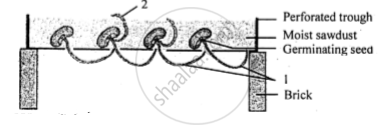
What is Thigmotropism? Give one example.
The following statement is about photosynthesis in a green plant. Write whether it is True or False.
Photosynthesis stops at a temperature above 35°C.
How does carbon dioxide return to the atmosphere? Explain.
A student in order to study the importance of certain factors of photosynthesis took a potted plant and kept it in the dark for over 24 hours. Then in the early hours of the morning the student covered one of the leaves with black paper in the centre only. Student placed the potted plant in the sunlight for a few hours, and then tested the leaf which was covered with black paper for starch.
(i) What aspect of photosynthesis was being investigated?
(ii) Is there any control in this experiment? If so, state the name.
(iii) Why was the plant kept in the dark before the experiment?
(iv) Describe step by step how the candidate proceeded to test the leaf for the presence of starch.
Complete the following food chain by writing the names of appropriate organisms in the blanks:
__________ → Mouse → _________ → Peaock
Complete the following sentence with appropriate word:
A light reaction is a ___________ reaction.
Mention, if the following statement is True or False. If false rewrite the wrong statement in its correct form:
KOH absorbs CO2.
Planting trees help in decreasing global warming.
