Advertisements
Advertisements
Question
Explain the phases in embryonic development from the morula stage till the establishment of pregnancy in a human female.
Advertisements
Solution
- The embryo with 8 to 16 blastomeres is called a morula.
- The morula continues to divide and transforms into a blastocyst as it moves further into the uterus.
- The blastomeres in the blastocyst are arranged into an outer layer called trophoblast and An inner group of cells attached to the trophoblast is called the inner cell mass.
- The trophoblast layer then gets attached to the endometrium, and the inner cell mass gets differentiated as the embryo.
- After attachment, the uterine cells divide rapidly and cover the blastocyst.
- As a result, the blastocyst becomes embedded in the endometrium of the uterus. This is called implantation and it leads to pregnancy.

Fertilisation and passage of growing embryo in the fallopian tube.
APPEARS IN
RELATED QUESTIONS
During the reproductive cycle of a human female, when, where and how does a placenta develop? What is the function of placenta during pregnancy and embryo development?
Gonads develop from embryonic ______.
The concentration of which of the following substances will decrease in the maternal blood as it flows from embryo to placenta through the umbilical cord?

The human foetus within the uterus
- Oxygen
- Amino Acids
- Carbon dioxide
- Urea
To answer the question, study the graphs below for Subjects 1 and 2 showing different levels of certain hormones.
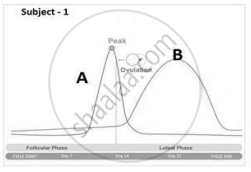
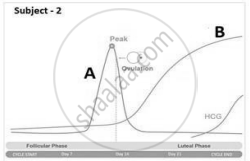
Subject 2 has a higher level of hormone B, which is ______
Several hormones like HCG, HPL estrogen, and progesterone are produced by ______.
Extra-embryonic membranes provide:
Except endocrine function, what are the other functions of placenta.
During embryogenesis in dicots, the zygote divides into a basal cell and a terminal cell. The basal cell divides repeatedly to produce a structure called suspensor. Carefully observe the image given below and describe the function of cell – A and cell – B of the suspensor.

Zygote
Which placental function is responsible for delivering O₂ from maternal blood to the fetus?
Which germ layer gives rise to the heart, blood vessels, muscles, and bones?
