Advertisements
Advertisements
Question
Explain the magnetic field created around a straight current carrying conductor with the help of a diagram.
Advertisements
Solution
- Consider a circuit connected as shown in the figure.

- A cardboard is placed around a thick copper wire. A magnetic needle is used to check the magnetic field around the wire.
- When a large current flows through the thick wire, the magnetic needle shows deflection. At different points on the cardboard, the needle points in different directions.
- When joined the directions shown by the needle, the lines formed indicate that the magnetic field produced around a current-carrying conductor is in the form of concentric circles.
- The deflection in the needle changes according to the current in the conductor. For a given current, if we move the compass needle away from the wire, its deflection decreases.
- The direction of the magnetic field formed around the conductor depends on the direction of the current and is given by the right-hand thumb rule.
- If the thumb of the right hand indicates the direction of the current then, the curled fingers indicate the direction of the magnetic field formed.
APPEARS IN
RELATED QUESTIONS
Fill in the following blank with suitable words:
The magnetic effect of a coil can be increased by increasing the number of ........... increasing the ........... or inserting an ........... core.
Fill in the following blank with suitable words:
If a coil is viewed from one end, and the current flows in a clockwise direction, then this end is a ........... pole.
If the direction of electric current in a solenoid when viewed from a particular end is anticlockwise, then this end of solenoid will be:
(a) west pole
(b) south pole
(c) north pole
(d) east pole
The magnetic effect of current was discovered by:
(a) Maxwell
(b) Fleming
(c) Oersted
(d) Faraday
Name one device which works on the magnetic effect of current.
What device reverses the current?
Which way does the wire in the diagram below tend to move?
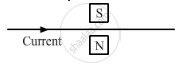
If fuse of 250 mA, 500 mA, 1 A, 5 A and 10 A were available, which one would be the most suitable for protecting an amplifier rated at 240 V, 180 W?
Write the correct option by observing the figures.
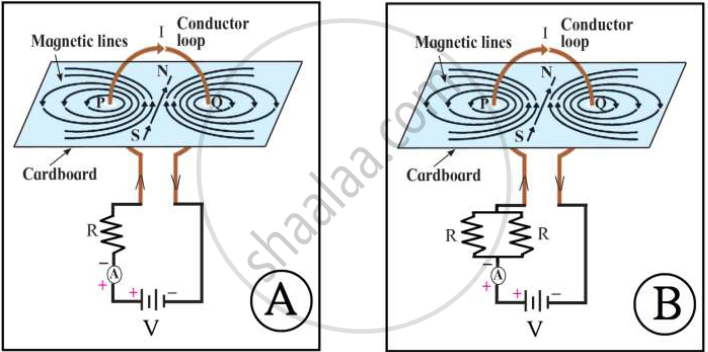
In the Activity shown below, how do we think the displacement of rod AB will be affected if
- current in rod AB is increased
- a stronger horse-shoe magnet is used
- length of the rod AB is increased?
|
Answer the following question:
State the effect on the magnetic needle in Oersted’s experiment when:
(a) the current is passed through the wire.
(b) the current through the wire is increased
(c) the current through the wire is reversed.
A soft iron bar is introduced inside the current-carrying solenoid. The magnetic field inside the solenoid ____________.
What is that instrument which can detect the presence of electric current in a circuit?
Unscramble the following words:
HTRCO
Paheli does not have a night lamp in her room. She covered the bulb of her room with a towel at the night to get dim light. Has she taken the right step? Give one reason to justify your answer.
How does the magnetic effect of electric current help in the working of an electric bell? Explain with the help of a diagram.
A student was asked to perform an experiment to study the force on a current carrying conductor in a magnetic field. He took a small aluminium rod AB, a strong horse shoe magnet, some connecting wires, a battery and a switch and connected them as shown. He observed that on passing current, the rod gets displaced. On reversing the direction of current, the direction of displacement also gets reversed. On the basis of your understanding of this phenomenon, answer the following questions:
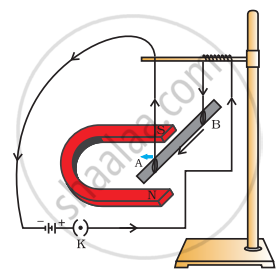
- Why does the rod get displaced on passing current through it?
- State the rule that determines the direction of the force on the conductor AB.
-
- If the U-shaped magnet is held vertically and the aluminium rod is suspended horizontally with its end B towards due north, then on passing current through the rod from B to A as shown, in which direction will the rod be displaced?
- Name any two devices that use current carrying conductors and magnetic fields.
OR
Draw the pattern of magnetic field lines produced around a current carrying straight conductor held vertically on a horizontal cardboard. Indicate the direction of the field lines as well as the direction of current flowing through the conductor.
Using an electromagnet, you can make a working model of a railway signal as shown in figure.

