Advertisements
Advertisements
Question
Explain the function of H2 – O2 fuel cell.
Advertisements
Solution
In this case, hydrogen act as a fuel and oxygen as an oxidant and the electrolyte is aqueous KOH maintained at 200°C and 20 – 40 atm. Porous graphite electrode containing Ni and NiO serves as the inert electrodes. Hydrogen and oxygen gases are bubbled through the anode and cathode, respectively.
Oxidation occurs at the anode:
\[\ce{2H2_{(g)} + 4OH^-_{( aq)} -> 4H2O_{(l)} + 4e^-}\]
Reduction occurs at the cathode:
\[\ce{O2_{(g)} + 2H2O_{(l)} + 4e^- -> 4OH^-_{( aq)}}\]
The overall reaction is \[\ce{2H2_{(g)} + O2_{(g)} -> 2H2O_{(l)}}\]
The above reaction is the same as the hydrogen combustion reaction, however, they do not react directly ie., the oxidation and reduction reactions take place separately at the anode and cathode respectively like H2 – O2 fuel cell. Other fuel cell like propane –O2 and methane O2 have also been developed.
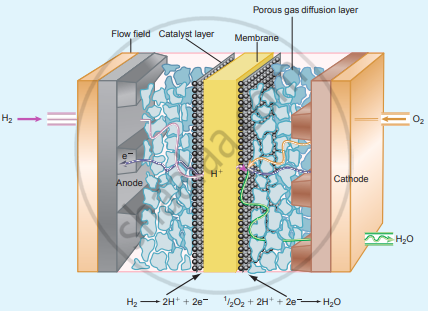
H2 – O2 fuel cell
APPEARS IN
RELATED QUESTIONS
Consider the following half cell reactions:
\[\ce{Mn^{2+} + 2e^- -> Mn}\] E0 = –1.18 V
\[\ce{Mn^{2+} -> Mn^{2+} + e^-}\] E0 = –1.51 V
The E0 for the reaction \[\ce{3Mn^{2+} -> Mn + 2Mn^{3+}}\], and the possibility of the forward reaction are respectively.
While charging lead storage battery
Among the following cells
I) Leclanche cell
II) Nickel – Cadmium cell
III) Lead storage battery
IV) Mercury cell
Primary cells are:
For the cell reaction
\[\ce{2Fe^{3+}_{( aq)} + 2l^-_{( aq)} -> 2Fe^{2+}_{( aq)} + l2_{( aq)}}\]
\[\ce{E^0_{cell}}\] = at 298 K. The standard Gibbs energy (∆G°) of the cell reactions is:
State Faraday’s Laws of electrolysis.
A current of 1.608A is passed through 250 mL of 0.5 M solution of copper sulphate for 50 minutes. Calculate the strength of Cu2+ after electrolysis assuming volume to be constant and the current efficiency is 100%.
Calculate the standard emf of the cell: \[\ce{Cd|Cd^{2+}||Cu^{2+}|Cu}\] and determine the cell reaction. The standard reduction potentials of Cu2+|Cu and Cd2+|Cd are 0.34 V and −0.40 volts respectively. Predict the feasibility of the cell reaction.
In fuel cell H2 and O2 react to produce electricity. In the process, H2 gas is oxidised at the anode and O2 at cathode. If 44.8 litre of H2 at 25°C and 1 atm pressure reacts in 10 minutes, what is average current produced? If the entire current is used for electro deposition of Cu from Cu2+, how many grams of deposited?
The same amount of electricity was passed through two separate electrolytic cells containing solutions of nickel nitrate and chromium nitrate respectively. If 2.935 g of Ni was deposited in the first cell. The amount of Cr deposited in the another cell?
Given: molar mass of Nickel and chromium are 58.74 and 52 gm−1 respectively.
Derive an expression for the Nernst equation.
