Advertisements
Advertisements
प्रश्न
Explain the function of H2 – O2 fuel cell.
Advertisements
उत्तर
In this case, hydrogen act as a fuel and oxygen as an oxidant and the electrolyte is aqueous KOH maintained at 200°C and 20 – 40 atm. Porous graphite electrode containing Ni and NiO serves as the inert electrodes. Hydrogen and oxygen gases are bubbled through the anode and cathode, respectively.
Oxidation occurs at the anode:
\[\ce{2H2_{(g)} + 4OH^-_{( aq)} -> 4H2O_{(l)} + 4e^-}\]
Reduction occurs at the cathode:
\[\ce{O2_{(g)} + 2H2O_{(l)} + 4e^- -> 4OH^-_{( aq)}}\]
The overall reaction is \[\ce{2H2_{(g)} + O2_{(g)} -> 2H2O_{(l)}}\]
The above reaction is the same as the hydrogen combustion reaction, however, they do not react directly ie., the oxidation and reduction reactions take place separately at the anode and cathode respectively like H2 – O2 fuel cell. Other fuel cell like propane –O2 and methane O2 have also been developed.
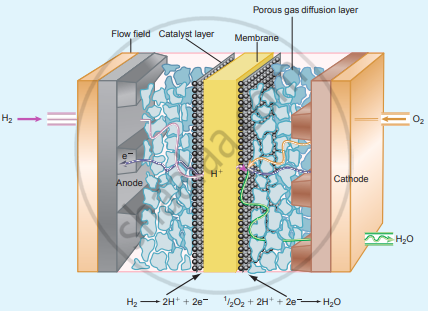
H2 – O2 fuel cell
APPEARS IN
संबंधित प्रश्न
Consider the following half cell reactions:
\[\ce{Mn^{2+} + 2e^- -> Mn}\] E0 = –1.18 V
\[\ce{Mn^{2+} -> Mn^{2+} + e^-}\] E0 = –1.51 V
The E0 for the reaction \[\ce{3Mn^{2+} -> Mn + 2Mn^{3+}}\], and the possibility of the forward reaction are respectively.
The button cell used in watches functions as follows.
\[\ce{Zn_{(s)} + Ag2O_{(s)} + H2O_{(l)} ⇌ 2Ag_{(s)} + Zn^{2+}_{( aq)} + 2OH^-_{( aq)}}\] the half cell potentials are \[\ce{Ag2O_{(s)} + H2O_{(l)} + 2e^- -> 2Ag_{(s)} + 2OH^-_{( aq)}}\] E0 = 0.34 V The cell potential will be
During electrolysis of molten sodium chloride, the time required to produce 0.1 mole of chlorine gas using a current of 3A is ___________.
The number of electrons delivered at the cathode during electrolysis by a current of 1A in 60 seconds is ____________.
(charge of electron = 1.6 × 10⁻¹⁹ C)
While charging lead storage battery
Among the following cells
I) Leclanche cell
II) Nickel – Cadmium cell
III) Lead storage battery
IV) Mercury cell
Primary cells are:
In \[\ce{H2 - O2}\] fuel cell the reaction occurs at cathode is:
In fuel cell H2 and O2 react to produce electricity. In the process, H2 gas is oxidised at the anode and O2 at cathode. If 44.8 litre of H2 at 25°C and 1 atm pressure reacts in 10 minutes, what is average current produced? If the entire current is used for electro deposition of Cu from Cu2+, how many grams of deposited?
8.2 × 10¹² litres of water is available in a lake. A power reactor using the electrolysis of water in the lake produces electricity at the rate of 2 × 10⁶ Cs−1 at an appropriate voltage. How many years would it like to completely electrolyse the water in the lake? Assume that there is no loss of water except due to electrolysis.
Derive an expression for the Nernst equation.
