Advertisements
Advertisements
Question
Explain how you will determine experimentally the position of the centre of gravity for a triangular lamina (or a triangular piece of cardboard).
Advertisements
Solution
Take a triangular lamina. Make three fine holes at a, b, and c near the edge of the triangular lamina. Now suspend the given lamina along with a plumb line from hole 'a'. Check that the lamina is free to oscillate about the point of suspension. When the lamina has come to rest, draw a straight line ad along the plumb line. Repeat the experiment by suspending the lamina through hole 'b' and then through hole 'c' for which we get straight lines to be and cf, respectively. It is noticed that the lines ad, be and cf intersect each other at a common point G, which is the position of the centre of gravity of the triangular lamina, i.e., the point of intersection of medians.

APPEARS IN
RELATED QUESTIONS
State a factor on which the position of the centre of gravity of a body depend? Explain your answer with an example.
What is the position of the centre of gravity of a cylinder?
At which point is the centre of gravity situated in a triangular lamina?
The figure shows three pieces of cardboard of uniform thickness cut into three different shapes. On each diagram draw two lines to indicate the position of the centre of gravity G.
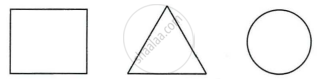
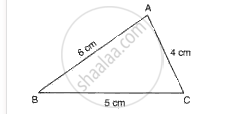
Fig. shows the dimensions of an acute angled triangle. By geometrical construction mark the C.G. of the triangle.
Explain why a ship loaded with light goods is more liable to be overturned than the one loaded with heavy goods.
Explain the term ‘centre of gravity’ of a body.
In ______ equilibrium, the centre of gravity remains at the same height when it is displaced.
What is centre of gravity ?
To find the Centre of Gravity of a laminar (2D) object, how many orientations should you suspend it from?
