Advertisements
Advertisements
Question
Explain the following with suitable examples:
Paramagnetism
Advertisements
Solution
- The substances that are attracted by a magnetic field are called paramagnetic substances.
- Some examples of paramagnetic substances are O2, Cu2+, Fe3+, etc.
- Paramagnetic substances get magnetised in a magnetic field in the same direction but lose magnetism when the magnetic field is removed.
- To undergo paramagnetism, a substance must have one or more unpaired electrons. This is because the unpaired electrons are attracted by a magnetic field, thereby causing paramagnetism.
RELATED QUESTIONS
What is ferromagnetism?
Iron (z=26) is highly ferromagnetic. Explain.
Define the following term:
Ferromagnetism
What type of substances would make better permanent magnets, ferromagnetic or ferrimagnetic. Justify your answer.
Analysis shows that nickel oxide has the formula Ni0.98O1.00. What fractions of nickel exist as Ni2+ and Ni3+ ions?
Give reasons:Ferrimagnetic substances show better magnetism than antiferromagnetic substances.
Explain why:
(i) Transition elements form coloured compounds.
(ii) Interhalogen compounds are more reactive than their constituent elements.
(iii) Cu+ is diamagnetic but Cu2+ is paramagnetic. (Z = 29)
Pyrolusite ore is _______.
The BH curve for a ferromagnetic material is shown in the figure. The material is placed inside a long solenoid which contains 1000 turns/cm. The current that should be passed in the solenonid to demagnetize the ferromagnet completely is
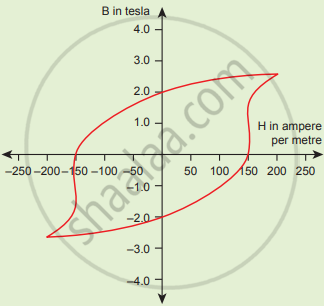
Give the properties of dia/para/ferromagnetic materials.
Example of ferromagnetic substance is ____________.
Fe3O4 is ____________.
Assertion: On heating ferromagnetic or ferrimagnetic substances, they become paramagnetic.
Reason: The electrons change their spin on heating.
Which of the following statements are correct?
(i) Ferrimagnetic substances lose ferrimagnetism on heating and become paramagnetic.
(ii) Ferrimagnetic substances do not lose ferrimagnetism on heating and remain ferrimagnetic.
(iii) Antiferromagnetic substances have domain structures similar to ferromagnetic substances and their magnetic moments are not cancelled by each other.
(iv) In ferromagnetic substances all the domains get oriented in the direction of magnetic field and remain as such even after removing magnetic field.
Which one of the following would feel attraction when placed in magnetic field: Co2+, Ag+, Ti4+, Zn2+
Which one of the following pairs has only paramagnetic species?
The heat of combustion of a substance is:
Which of the following statements are correct?
- Electric monopoles do not exist whereas magnetic monopoles exist.
- Magnetic field lines due to a solenoid at its ends and outside cannot be completely straight and confined.
- Magnetic field lines are completely confined within a toroid.
- Magnetic field lines inside a bar magnet are not parallel.
- χ = -1 is the condition for a perfect diamagnetic material, where x is its magnetic susceptibility.
The value of aluminium susceptibility is 2.2 × 10⁻⁵. The percentage increase in the magnetic field if space within a current carrying toroid is filled with aluminium is `"x"/10^4`. Then the value of x is ______.
Among the following ions, which one has the highest paramagnetism?
Which of the following is not paramagnetic?
Match items of List - I with those of List - II:
| List - I | List - II | ||
| (Property) | (Example) | ||
| (A) | Diamagnetism | (i) | MnO |
| (B) | Ferrimagnetism | (ii) | O2 |
| (C) | Paramagnetism | (iii) | NaCl |
| (D) | Antiferromagnetism | (iv) | Fe3O4 |
Choose the most appropriate answer from the options given below:
Which one of the following compounds is diamagnetic and colourless?
Give a reason for the following:
Cu+2 salts are paramagnetic, while Cu+ salts are diamagnetic.
The metal complex ion that is paramagnetic is ______.
(Atomic number of Fe = 26, Cu = 29, Co = 27 and Ni = 28)
