Advertisements
Advertisements
Question
Explain the construction and working of the following. Draw a neat diagram and label it.
Electric Generator (AC)
Advertisements
Solution
Electric Generator principle : An electric generator is a machine that generates electricity by rotating its rotor in a magnetic field. Thus, it converts mechanical energy into electrical energy.
Construction: A generator consists of a rectangular coil MNST of insulated copper wire placed between two strong magnetic poles. The two ends of the coil MNST are connected with brushes A and B of rings C and D respectively. The inner sides of the rings are insulated. They are attached with an axle X, which can be rotated mechanically. Brushes A and B are connected with a galvanometer that can measure the flow of current in coil MNST.
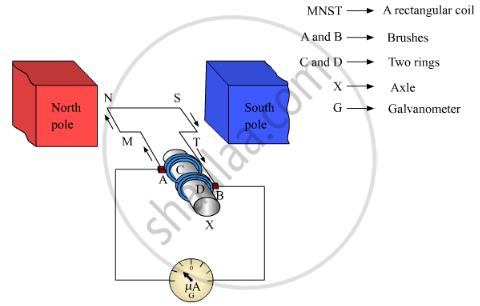
Working: When the axle is rotated, lengths MN and ST move up and down respectively. Since lengths MN and ST are moving in a magnetic field, a current gets induced in these lengths caused by an electromagnetic induction. The direction of the induced current in both the lengths is given by Fleming’s right hand rule.
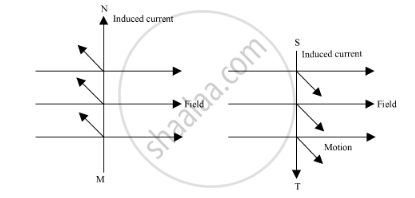
Since length MN is moving upwards in the magnetic field that acts from left to right, the direction of the induced current will be from M to N. Similarly, the direction of the induced current in length ST will be from S to T. Hence, an induced current will set up in the coil in the direction MNST, which produces deflection in the galvanometer.
After half-rotation, length MN starts moving down, whereas length ST starts moving up. The direction of the induced current in the coil gets reversed i.e., the induced current will now flow from T to M via S and N i.e., TSNM. Therefore, we can conclude that after each half-rotation, the direction of the induced current is reversed. This current is called an alternating current (AC). An AC reverses its direction after equal time intervals.
APPEARS IN
RELATED QUESTIONS
State the principle of an electric generator.
State whether the following statement is true or false.
An electric motor converts mechanical energy into electrical energy.
Explain the underlying principle and working of an electric generator by drawing a labelled diagram. What is the function of brushes?
Name the device which converts mechanical energy into electric energy.
Name the phenomenon which is made use of in an electric generator.
State two ways in the which the current alternating current and direct current?
Each one of the following changes will increase emf (or voltage) in a simple generator except:
(a) increasing the number of turns in the armature coil
(b) winding the coil on a soft iron armature
(c) increasing the size of the gap in which the armature turns
(d) increasing the speed of rotation
An electric generator converts:
(a) electrical energy into mechanical energy.
(b) mechanical energy into heat energy.
(c) electrical energy into chemical energy.
(d) mechanical energy into electrical energy.
A d.c. generator is based on the principle of:
(a) electrochemical induction
(b) electromagnetic induction
(c) magnetic effect of current
(d) heating effect of current
The frequency of alternating current (a.c.) supply in India is:
(a) 0 Hz
(b) 50 Hz
(c) 60 Hz
(d) 100 Hz
What determines the frequency of a.c. produced in a generator?
Draw a labelled diagram of a simple a.c. generator.
In an a.c. generator the speed at which the coil rotates is doubled. How would this affect
- the frequency of output voltage,
- the maximum output voltage is doubled.
What energy conversion does take place in a generator when it is in use?
The part of the AC generator that passes the current from the armature coil to the external circuit is ______.
Draw and label the diagram of an AC generator.
To convert an AC generator into DC generator ____________.
An AC generator is provided with ______ slip rings that rotate with the coil.
