Advertisements
Advertisements
प्रश्न
Explain the construction and working of the following. Draw a neat diagram and label it.
Electric Generator (AC)
Advertisements
उत्तर
Electric Generator principle : An electric generator is a machine that generates electricity by rotating its rotor in a magnetic field. Thus, it converts mechanical energy into electrical energy.
Construction: A generator consists of a rectangular coil MNST of insulated copper wire placed between two strong magnetic poles. The two ends of the coil MNST are connected with brushes A and B of rings C and D respectively. The inner sides of the rings are insulated. They are attached with an axle X, which can be rotated mechanically. Brushes A and B are connected with a galvanometer that can measure the flow of current in coil MNST.
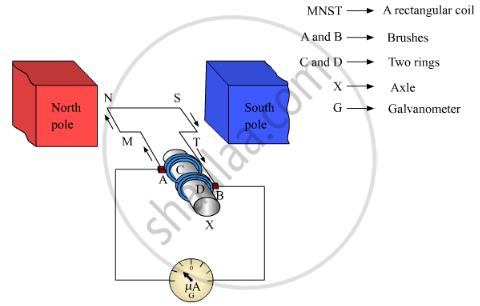
Working: When the axle is rotated, lengths MN and ST move up and down respectively. Since lengths MN and ST are moving in a magnetic field, a current gets induced in these lengths caused by an electromagnetic induction. The direction of the induced current in both the lengths is given by Fleming’s right hand rule.
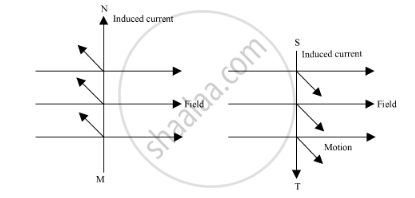
Since length MN is moving upwards in the magnetic field that acts from left to right, the direction of the induced current will be from M to N. Similarly, the direction of the induced current in length ST will be from S to T. Hence, an induced current will set up in the coil in the direction MNST, which produces deflection in the galvanometer.
After half-rotation, length MN starts moving down, whereas length ST starts moving up. The direction of the induced current in the coil gets reversed i.e., the induced current will now flow from T to M via S and N i.e., TSNM. Therefore, we can conclude that after each half-rotation, the direction of the induced current is reversed. This current is called an alternating current (AC). An AC reverses its direction after equal time intervals.
APPEARS IN
संबंधित प्रश्न
State the principle of an electric generator.
The device used for producing electric current is called a ______.
A coil of insulated copper wire is connected to a galvanometer. What will happen if a bar magnet is pushed into the coil?
Explain the underlying principle and working of an electric generator by drawing a labelled diagram. What is the function of brushes?
Name the phenomenon which is made use of in an electric generator.
What change should be made in an a.c. generator so that it may become a d.c. generator?
What is the major difference between the simple alternator and most practical alternators?
State two ways in the which the current alternating current and direct current?
Each one of the following changes will increase emf (or voltage) in a simple generator except:
(a) increasing the number of turns in the armature coil
(b) winding the coil on a soft iron armature
(c) increasing the size of the gap in which the armature turns
(d) increasing the speed of rotation
An electric generator converts:
(a) electrical energy into mechanical energy.
(b) mechanical energy into heat energy.
(c) electrical energy into chemical energy.
(d) mechanical energy into electrical energy.
Suggest two ways in an a.c. generator to produce a higher e.m.f.
What energy conversion does take place in a generator when it is in use?
State one advantage of using a.c. over d.c.
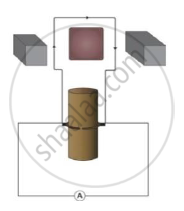
Observe the figure and answer the following questions.
a) Identify the machine shown in figure.
b) Write a use of this machine.
c) How transformation of energy takes place in this machine.
A flat coil of wire rotates at a constant speed about an axis perpendicular to a uniform magnetic field. Draw a graph to show how the induced e.m.f. varies relative to the positions of the coil during its one complete rotation. At what position of the coil, the e.m.f. has the maximum value?
A device for producing electric current is ______.
A coil of insulated copper wire is connected to a galvanometer forming a loop and a magnet is:
A: Held stationary
B: Moved away along its axis
C: Moved towards along its axis
D: There will be an induced current in
A coil of insulated copper wire is connected to a galvanometer. What will happen if a bar magnet is held stationary inside the coil?
An AC generator is provided with ______ slip rings that rotate with the coil.
