Advertisements
Advertisements
प्रश्न
Explain the construction and working of the following. Draw a neat diagram and label it.
Electric motor
Explain the construction and working of electric motor in short.
Advertisements
उत्तर
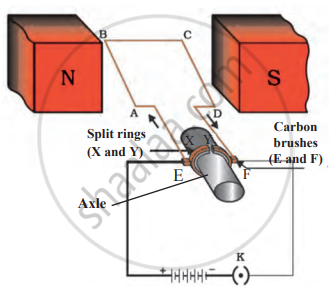
- Construction: Electric motor consists of the following parts:
- Rectangular coil: A large number of turns of insulated copper wire wound on iron core in rectangular shape forms a coil ABCD as shown in following figure.
- Strong magnet: The coil is placed in between two pole pieces (N and S) of a strong horse shoe magnet which provides a strong magnetic field. The sides AB and CD are perpendicular to the direction of the magnetic field.
- Split ring: It consists of two halves of a metallic ring (X and Y). The ends of the coil are connected to these rings. The outer conducting surfaces of spilt rings X and Y are in contact with the two stationary carbon brushes. Spilt rings reverse the direction of current in the coil.
- Brushes: Two carbon brushes E and F are used to press the split rings.
- Axle: The two halves of the rings have a resistive coating in their inner surfaces and are tightly fitted on the axle. The main function of an axle is to rotate with the coil.
- Battery: The battery supplies the current to the coil.
- Working:
- When the circuit is completed, the current passes through the brush E from A to B in branch AB.
- As, the magnetic field acts from north pole to south pole, according to Fleming’s left-hand rule, the force experienced by arm AB is in the downward direction and arm CD is in the upward direction.
- Both these forces are equal in magnitude and opposite in direction and hence, the coil rotates in an anticlockwise direction.
- After half rotation, the split rings X and Y come in contact with brushes E and F respectively.
- Again the current starts passing through the coil in opposite direction.
- The force acting on branch BA is upward and DC is downward, this force again moves the coil in an anticlockwise direction.
- This shows that the current in the loop ABCD is reversed after every half rotation, and the loop continues to rotate in the same direction.
- Thus, the coil rotates with the help of electrical energy.
APPEARS IN
संबंधित प्रश्न
What do the following symbols mean in circuit diagrams?
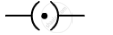
Draw circuit symbols for variable resistance
What is a circuit diagram
Draw the labelled diagram of an electric circuit comprising of a cell, a resistance, an ammeter, a voltmeter and a closed switch (or closed plug key). Which of the two has a large resistance : an ammeter or a voltmeter?
Explain with the help of a labelled circuit diagram how you will find the resistance of a combination of three resistors, or resistance R1, R2 and R3, joined in parallel. Also mention how you will connect the ammeter and the voltmeter in the circuit when measuring the current in the circuit and the potential difference across one of the three resistors of the combination.
Tell the odd one out. Give a proper explanation.
Write the condition required for a circuit to be a closed circuit.
Explain the following:
Closed circuit
If you touch an electric wire carrying current you get a shock, but if on the same wire the birds sit they do not get any shock/current. Explain why?
Flow of electricity through a closed circuit is _____.
______ is the device used to close or open an electric circuit.
Tabulate the different components of an electric circuit and their respective symbols.
Rahul wants to make an electric circuit. He has a bulb, two wires, a safety pin, and a piece of copper. He does not have any electric cell or battery. Suddenly he gets some idea. He uses lemon instead of a battery and makes a circuit. Will the bulb glow?
Higher Order Question
A student made a circuit by using an electric cell, a switch, a torch bulb (fitted in the bulb holder), and copper connecting wires. When he turned on the switch, the torch bulb did not glow at all. The student checked the circuit and found that all the wire connections were tight.
- What could be the possible reason for the torch bulb not glowing even when the circuit appears to be complete?
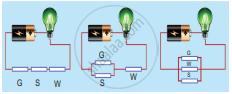
Study the three electric circuits below. Each of them has a glass rod (G), a steel rod (S), and a wooden rod (W).
In which of the electric circuits would the bulb not light up.
Fuse is
Assertion: People struck by lightning receive a severe electrical shock.
Reason: Lightning carries very high voltage.
What is electric circuit?
In a simple circuit, why does the bulb glow when you close the switch?
When a circuit is open, _____ cannot pass through it.
______ is a kind of fish which is able to produce an electric current.
In an electrical circuit three incandescent bulbs A, B and C of rating 40 W, 60 W and 100 W respectively are connected in parallel to an electric source. Which of the following is likely to happen regarding their brightness?
In an electrical circuit two resistors of 2 Ω and 4 Ω respectively are connected in series to a 6 V battery. The heat dissipated by the 4 Ω resistor in 5 s will be
Draw a circuit diagram of an electric circuit containing a cell, a key, an ammeter, a resistor of 2 Ω in series with a combination of two resistors (4 Ω each) in parallel and a voltmeter across the parallel combination. Will the potential difference across the 2 Ω resistor be the same as that across the parallel combination of 4 Ω resistors? Give reason.
Name the device used these days in place of electric fuses in electrical circuits.
Observe the circuit given:
1. Would any of the bulbs glow when the switch is in the ‘OFF’ position?
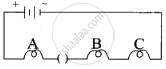
2. What will be the order in which the bulbs A, B, and C will glow when the switch is moved to the ‘ON’ position?

In the above circuit, if the current reading in the ammeter A is 2A, what would be the value of R1?
The ______ is a species of fish that can give electric shocks of up to six hundred fifty watts of electricity.
Match the following
| 1. | Insulator | a. | Coulomb |
| 2. | Conductor | b. | Electric circuit |
| 3. | Closed path | c. | Copper |
| 4. | Electric charge | d. | Rubber |
Paheli is running short of connecting wires. To complete an electric circuit, she may use a ______.
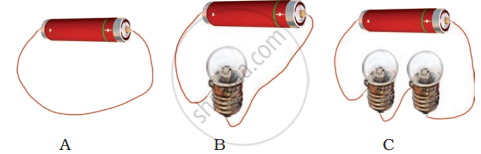
In which of the following circuits A, B and C given in the following figure, the cell will be used up very rapidly?
Write a short note on the different electrical circuits.
Overloading of electric circuits can lead to short-circuiting.
Set up the circuit shown in Figure again. Move the key to ‘ON’ position and watch carefully in which direction the compass needle gets deflected. Switch ‘OFF’ the current. Now keeping rest of the circuit intact, reverse the connections at the terminal of the cell. Again switch ‘on’ the current. Note the direction in which the needle gets deflected. Think of an explanation.