Advertisements
Advertisements
Question
Advertisements
Solution 1
During the day transpiration and photosynthesis are interlinked as the stomata opens to facilitate the inward diffusion of carbon dioxide for photosynthesis which also leads to loss of water vapours to the outside during transpiration.
Solution 2
During the day, the chloroplast in the guard cells are able to carry on photosynthesis, so the osmotic pressure in the cell sap of the guard cells is high and water enters the guard cells which lead to an opening of the stomatal aperture. Thus stomatal transpiration can take and CO2 can also enter the green leaf to enable photosynthesis to take place. So, during day time photosynthesis and stomatal transpiration occurs simultaneously.
RELATED QUESTIONS
Given below is an experiment setup to demonstrate a particualr tropic movement in germinating seeds. Study the diagram and answer the questions that follow :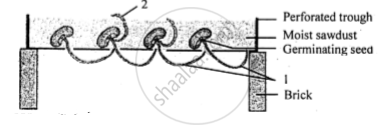
(ii) Name the tropic movement shown by part 1.
Define the following:
Organic food
Fill in the blank:
______ is the process which replenishes the atmospheric oxygen which the animal life consumes in respiration.
The production of starch, and not glucose, is often used as a measure of photosynthesis in leaves because
Complete the following sentence with appropriate word:
A dark reaction is a __________ reaction.
Choose the correct option.
The sequential order in electron transport from PSII to PSI of photosynthesis is ______.
The green pigment present in the plant is ______.
State whether true or false. If false, correct the statement.
When the weather is hot, water evaporates lesser which is due to opening of stomata.
Where do the light-dependent reaction and the Calvin cycle occur in the chloroplast?
In leaves, the food is stored in the form of ______.
