Advertisements
Advertisements
Question
Expand the following outline into complete story and supply a suitable title for each.
Mr. X, a rich businessman – runs a company - always very busy with office work – one day his son – 10 years old – approaches dad and asks – how much he earns in one hour – father gets furious – boy persuades – father says Rs. 500 – immediately son asks for Rs. 300 – father shouts – wasting money on toys - son leaves to his room crying – father feels bad – thinks might need some stationery – enters boy’s room and gives money – boy becomes happy – takes some crumpled notes – under his pillow – counts everything together – total Rs.500 – gives it to dad – wants to buy – one hour of his time – father realizes his mistake – feels sorry and guilty – hugs son – closes
Advertisements
Solution
Sons Love for his father
Mr. X is a rich businessman. He runs a company. He is always busy with his office work. Like a snail, he carries his office workers everywhere. His young son one day asks him, “How much do you earn in an hour?”. The father gets furious and refuses to reply. But the son coaxes him to give the answer. The father grudgingly says, “Rs. 500/- an hour”. Immediately the boy asks his dad to give him three hundred rupees. He reprimands his son for trying to waste his hard-earned money. The boy cries and goes to the bedroom without dinner. The father feels guilty. He realizes that the boy might really need the money for buying some stationery. He gives him three hundred rupees. The next moment, the boy collected all the crumpled notes from under his pillow. Dad asks, “why did you ask for money when you have so much?”. Without replying the boy handed him Rs. 500/- and said, “This is the amount you earn in an hour, I have given you that money. Now, will you spend an hour with me?”. The father realizes his mistake. He takes the boy out on a picnic. Then onwards he regularly spends time with him.
APPEARS IN
RELATED QUESTIONS
Underline the verb form in the following sentence and state its Tense and Aspect.
They are waiting for the right winds.
From each line in the poem, pick out the word that is a homograph. Write its meaning in the context of the phrase used in the poem. Then write the other meaning implied in the question.
| Stanza | Word | One meaning | Other meaning | |
| First |
|
piece of furniture | → | bottom of the river, sea, etc. |
| Second |
|
____________ | → | ____________ |
| Third |
|
____________ | → | ____________ |
He didn’t turn up ____________ his busy schedule.
Write the gerund/infinitive form of the verb in the blank.
We really look forward _____________ (meet) alien creatures and ________ (find) out what they are really like.
______ open the window? It is very hot in the room.
Change the following into passive voice.
Stanley will inform you later.
Kokila gave a pen to ______ child in the classroom on her birthday.
India is ________ largest democracy in the world.
Refer to your dictionary. Add a prefix or suffix to the following words and find their antonyms.
| 1. | privileged | |
| 2. | animate | |
| 3. | discriminate | |
| 4. | empty | |
| 5. | communicate | |
| 6. | learn |
Choose the correct antonym for the italic word.
Ajay mastered the techniques of painting.
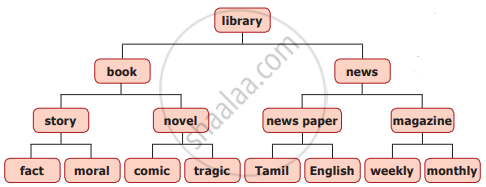
Read the list of words. Write down all the words related to those words. Create a “map” using a graphic organizer and discuss it in groups. One is done for you.
| library | building | garden | student |
| teacher | advertisement | animal | art |
Work in pairs and say the sentence to each other. Do you hear any difference in the way it is spoken? Discuss and share with the class. Discuss the difference in the meaning of the sentence.
What a beautiful banyan tree!
Choose the correct plural form.

Bush
Give the correct verb form for following sentence.
He ______ to school.
Change the following sentence to present perfect tense.
She writes a letter to her friend.
Choose the correct word.

They went _____ the park.
Write the correct clipped word on the line.
I have an _______ (examination) next week.
Write

______ unicorn
Form meaningful sentence using the given word to bring out at least two different meaning.
light
Add appropriate question tag to the following sentence.
Automation and shared mobility will play a key role in this transformation.
Give the meaning of the following phrasal verb and frame sentence using them
turn away
Recall your learning of basic preposition and complete the sentence using the prepositions given in options.
There is usually a garden ______a bungalow
Complete the following passage using the preposition given in bracket.
(among, for, at, to, in, )
When Lakshmi was (1) ___ school, she practised music from Monday (2) ___ Friday. She involved herself (3) ___ the school orchestra. She was responsible (4) ___conducting many programmes. She was very popular (5) ___ her schoolmates, as she was kind, friendly and helpful.
Choose the appropriate linker from within the options and complete the sentence.
______ she can drive, she travels by bus.
Frame illustrative sentence to distinguish the meaning of the word in the following cluster.
raise – rise– rice
Identify the error in each of the following sentence and rewrite them Correctly.
Many a student were awarded at the function.
Find the meaning of the following from a good dictionary:
inscriptions
Try this variation-
Prepare sentences which have as many letters in each word as there are words in that sentence.
Examples:
- Go in.
- You are out.
- Come here soon, dear.
- Bring those seven shiny belts.
Write compound word using the picture.
 |
+ |  |
| ____________ | ||
