Advertisements
Advertisements
Question
Equal Parts of a Triangle
The white triangle is divided into three equal parts. Fill each one-third part with a different colour. Can you show that these parts are equal? Think how.

Advertisements
Solution
Since one triangle is divided into three equal parts, therefore, each part is one-third `(1/3)` of the whole triangle. Let us `1/3` in each part and colour them in a different colour as shown in the above figure.
In order to show that these parts are equal. Let us name them, T1 T2 and T3. Trace any of them, say T1. Now place traced part over T2 and T3. We find that T1 covers T1, T2 and T3 are of the same shape and size. Hence, these triangles are equal.
RELATED QUESTIONS
Write the fraction shown by the shaded part.
Find out which is greater in the following fractions.
`5/12` and `7/12`
Chocolate Bar
Manju had chocolate. She gave one-fourth of it to Raji, one-third to Sugatha, and one-sixth to Sheela. She ate the remaining part. How many pieces of chocolate did each get? Write here.

What part of the chocolate did Manju eat?
Colour the Hats
Colour `1/3` of the hat's red.
Colour three-fifth of hats blue.
How many hats did you colour red?
Six parts of a Rectangle
Rani has divided a green rectangle into six equal parts like this.

Now you divide each of these rectangles into six equal parts. Use a different way for each of the three rectangles.
Look at the figures and write ‘<’ or ‘>’, ‘=’ between the given pairs of fractions.
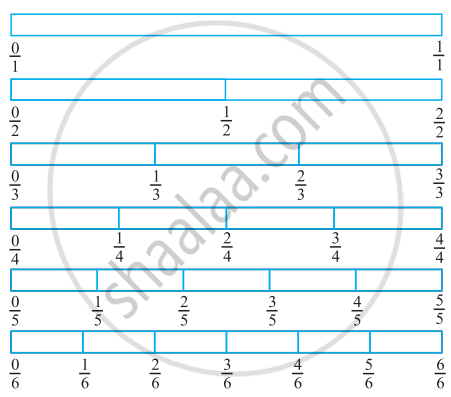
`5/6 ☐ 5/5`
How quickly can you do this? Fill appropriate sign.
`1/4 ☐ 2/8`
Rafiq exercised for `3/6` of an hour, while Rohit exercised for `3/4` of an hour. Who exercised for a longer time?
Describe two methods to compare `13/17` and 0.82. Which do you think is easier and why?
For fractions with the same numerator, which fraction is larger?
