Advertisements
Advertisements
Question
Enlist different types of restriction enzymes commonly used in rDNA technology? Write about their role.
Advertisements
Solution
There are three types of restriction enzymes:
- Type I – These enzymes function simultaneously as endonuclease and methylase e.g. EcoK.
- Type II – These enzymes have separate activities for cleaving and methylation; they are more stable and are used in rDNA technology e.g. EcoRI, BglII; these enzymes cut DNA at specific sites within the palindrome. There are thousands of type II restriction enzymes that are recognized/ discovered.
- Type III – These enzymes cut DNA at specific non-palindromic sequences e.g. HpaI, MboII.
Role of restriction enzymes:
Restriction enzymes either cut straight across the DNA in the region of palindrome to give blunt ends or cuts producing short, single-stranded projections at each end of DNA to produce, cohesive or sticky ends or staggered ends.
APPEARS IN
RELATED QUESTIONS
The biological scissor is ______.
Describe two vectors less methods of gene transfer used in rDNA technology.
What is the role of Taq-polymerase in PCR technology?
Vectors are ____________ molecules that carry a foreign gene and replicate inside the host cell.
Identify the characters that a cloning vector should possess.
i. Origin of replication (Ori)
ii. Ability to destroy the alien DNA
ii. Cloning site to link the alien DNA
iv. The tumour inducing plasmid Ti
v. Selectable marker
vi. Low molecular weight
A recombinant DNA molecule was created by ligating a gene to a plasmid vector. By mistake, an exonuclease was added to the tube containing the recombinant DNA. How does this affect the next step in the experiment i.e. bacterial transformation?
Annealing step of PCR operates at ______ °C.
The PCR technique is used for ______.
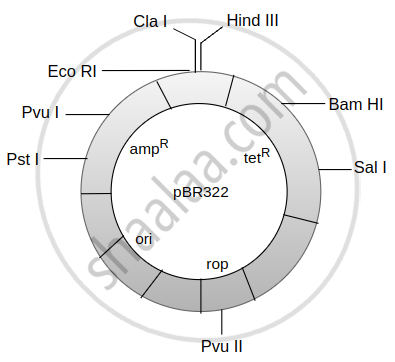
The given figure is the diagrammatic representation of the E. coli vector pBR322. Which one of the given options correctly indentites its certain component(s)?
In vitro amplification of DNA segments is called______.
