Advertisements
Advertisements
Question
Each of the three states of matter has mass. Explain with the help simple experiments – that each state of matter has mass.
Advertisements
Solution
Matter i.e. solids, liquids, and Gases have mass explained by the following experiments.
(1) Solid
Experiment: A solid placed on one side of the scale, causes the scale to tilt towards one side.
Conclusion: The scale tilts due to the mass of the solid, hence all solids have mass.
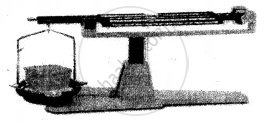
(2) Liquid:
Experiment: A liquid placed on one side of the scale, causes the scale to tilt towards one side.
Conclusion: The scale tilts due to the mass of the liquid, hence all liquids have mass.

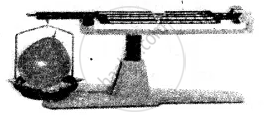
(3) Gas:
Experiment: An inflated balloon placed on one side of the scale causes it to tilt towards one side.
Conclusion: The scale tilts due to the mass of the gas, hence all gases have mass.
APPEARS IN
RELATED QUESTIONS
Fill in the blank:
Liquids have no definite ............
Write whether the following statement is true or false.
All solids, on heating, first change to the liquid and then to the gaseous state always.
Gases
- cannot be compressed easily,
- occupy the entire space of the container.
- have definite shapes.
- cannot flow.
If an object weighs 6 N on earth what will be its weight on moon. What will be the change in its mass?
Fill in the blank:
The quantity of matter in an object is called its _____
Differentiate the general properties of solids, liquids and gases in the form of a table — with reference to compressibility.
State in which of the following examples ie. a piece of wood, water, light gas is the Inter-particle space maximum.
Among the following ______ is not a mixture.
Mr. Raghu returns home on a hot summer day and wants to have buttermilk. Mrs. Raghu has the only curd. What can she do to get buttermilk? Explain
Which one of the following element name is not derived from planet?
