Advertisements
Advertisements
Question
A measuring cylinder is filled with water to a particular mark. A piece of solid is immersed inside the measuring cylinder. State why the level of water in the measuring cylinder will rise up. If the solid is removed, what will be the new level of the water in the measuring cylinder? Give a reason for your answer.
Advertisements
Solution
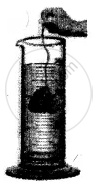
When a piece of solid stone is immersed inside the measuring cylinder. The water level rises up.
On removal of solid stone, the water level in the measuring cylinder falls down back to the mark ‘A’.
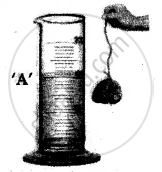
Hence, It shows that the stone occupies the space of the water and thus pushes the water level up. This experiment or procedure also proves that all solids occupy space.
APPEARS IN
RELATED QUESTIONS
Fill in the blank:
The temperature at which a liquid starts changing into its vapour state is ______.
Name the phenomenon which cause the following change:
Formation of water vapour from water.
A kind of matter which can sublinje is
- water
- plastic
- milk
- iodine
A substance which can change its state
- wood
- oxygen
- paper
- cloth
A solid is a state of matter that has
State two characteristics of matter demonstrated by diffusion.
State the term which refers to the conversion of a substance on heating from.
- solid-state to liquid state
- liquid state to vapour state
- vapour state to liquid state
- liquid state to solid-state.
State in which of the following examples ie. a piece of wood, water, light gas is the Energy possessed by particles of matter, very large.
‘Inter-particle attraction between atoms of gases is very weak’. State five properties of gases which correlate as a consequence of the weak inter-particle attraction between particles of gases.
In a glass containing some water, tamarind juice and sugar are added and stirred well. Is this a mixture? Can you tell why? Will this solution be sweet or sour or both sweet and sour?
