Advertisements
Advertisements
प्रश्न
A measuring cylinder is filled with water to a particular mark. A piece of solid is immersed inside the measuring cylinder. State why the level of water in the measuring cylinder will rise up. If the solid is removed, what will be the new level of the water in the measuring cylinder? Give a reason for your answer.
Advertisements
उत्तर
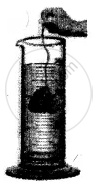
When a piece of solid stone is immersed inside the measuring cylinder. The water level rises up.
On removal of solid stone, the water level in the measuring cylinder falls down back to the mark ‘A’.
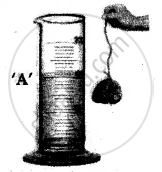
Hence, It shows that the stone occupies the space of the water and thus pushes the water level up. This experiment or procedure also proves that all solids occupy space.
APPEARS IN
संबंधित प्रश्न
Why do solids, liquids and gases differ in their physical states ?
Write whether the following statement is true or false.
The intermolecular force of attraction is the weakest in gases.
All kinds of matter
- occupy space and have definite mass
- have mass and definite shape
- can change their states
- have definite volume
What is volume ?
Give reason of A gas fills up the space available to it.
Fill in the blank
When a gas is cooled, its molecules ________ energy,
Even two or three crystals of potassium permanganate can impart colour to a very large volume of water. Which characteristic of particles of matter is illustrated by this observation?
Describe simple experiment to show that particles of matter are closely packed in solids and less in liquids.
Complete the blank with reference to interconversion of matter on the basis of kinetic theory-with the word ‘increase’, ‘decreases’, ‘gain’, ‘lose’, or ‘overcome’ in the following case.
During sublimation, the inter-particle attraction is _______________.
You are provided with a mixture of naphthalene and ammonium chloride by your teacher. Suggest an activity to separate them with well labelled diagram.
