Advertisements
Advertisements
प्रश्न
Describe simple experiment to show that particles of matter are closely packed in solids and less in liquids.
Advertisements
उत्तर
Experiment – To show that particles are closely packed in solids and less in liquids
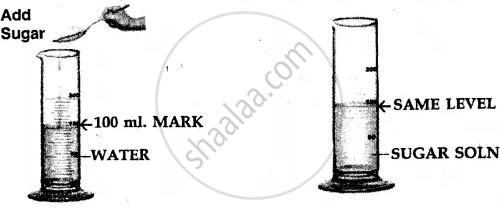
Procedure –
- Take a measuring cylinder and add 100 ml. of water to it.
- Add crystals of sugar [solid] to the water and stir carefully to obtain a sugar solution.
- The volume of water after the addition of sugar remains the
same i.e. at 100 ml. mark.
Conclusion –
- Particles of a liquid [e.g. water] are less closely packed.
- Particles of a solid [e.g. sugar] are closely packed.
- The sugar particles fill the intermolecular spaces, which must be existing between the water molecules, and hence the level of water in the measuring cylinder does not rise.
APPEARS IN
संबंधित प्रश्न
Give reasons:
Solids cannot be compressed.
Fill in the blank:
Liquids have no definite ............
Fill in the blank :
Air is a matter because it has ________ and _______ and it can be _________
If an object weighs 6 kg on earth. What will be its weight on moon ?
State in which of the three states of matter:
The space between the particles is minimum.
State in which of the three states of matter:
The movement of the particles is neither about their own positions nor in any random direction.
Fill in the blank:
The three states of matter are classified on the basis of differences of certain _________.
Fill in the blank:
The intermolecular force of attraction is ___________ in solids.
Water obtained from tube wells is usually ______ water.
The Cow and Birds are nonliving things.
