Advertisements
Advertisements
Question
Describe simple experiment to show that particles of matter are closely packed in solids and less in liquids.
Advertisements
Solution
Experiment – To show that particles are closely packed in solids and less in liquids
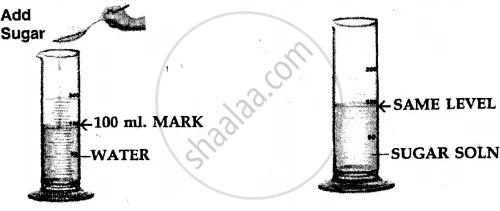
Procedure –
- Take a measuring cylinder and add 100 ml. of water to it.
- Add crystals of sugar [solid] to the water and stir carefully to obtain a sugar solution.
- The volume of water after the addition of sugar remains the
same i.e. at 100 ml. mark.
Conclusion –
- Particles of a liquid [e.g. water] are less closely packed.
- Particles of a solid [e.g. sugar] are closely packed.
- The sugar particles fill the intermolecular spaces, which must be existing between the water molecules, and hence the level of water in the measuring cylinder does not rise.
APPEARS IN
RELATED QUESTIONS
Fill in the blank:
Any matter which has a definite.................... but no definite shape is called a...............
Write whether the following statement is true or false.
If the container in which a gas is collected has an opening, the gas will flow out and spread itself indefinitely.
Write whether the following statement is true or false.
There is no difference between evaporation and boiling.
For the following statement, say whether it describes a solid, a liquid or a gas.
Particles move about very quickly.
Name the phenomenon which cause the following change:
Conversion of ice into water.
Write whether the following statement are true or false.
The intermolecular force of attraction is the weakest in gases.
State two characteristics of matter demonstrated by diffusion.
In which of the following conditions, the distance between the molecules of hydrogen gas would increase?
- increasing pressure on hydrogen contained in a closed container
- some hydrogen gas leaking out of the container
- increasing the volume of the container of hydrogen gas
- adding more hydrogen gas to the container without increasing the volume of the container
Which of the following statement is incorrect?
Explain the term ‘interconversion of matter’ with ice as a starting material.
