Advertisements
Advertisements
प्रश्न
Each of the three states of matter has mass. Explain with the help simple experiments – that each state of matter has mass.
Advertisements
उत्तर
Matter i.e. solids, liquids, and Gases have mass explained by the following experiments.
(1) Solid
Experiment: A solid placed on one side of the scale, causes the scale to tilt towards one side.
Conclusion: The scale tilts due to the mass of the solid, hence all solids have mass.
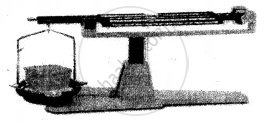
(2) Liquid:
Experiment: A liquid placed on one side of the scale, causes the scale to tilt towards one side.
Conclusion: The scale tilts due to the mass of the liquid, hence all liquids have mass.

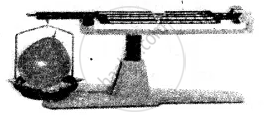
(3) Gas:
Experiment: An inflated balloon placed on one side of the scale causes it to tilt towards one side.
Conclusion: The scale tilts due to the mass of the gas, hence all gases have mass.
APPEARS IN
संबंधित प्रश्न
Which of the following are matter?
Chair, air, love, smell, hate, almonds, thought, cold, lemon water, smell of perfume.
When sodium chloride is added to a definite volume of water and stirred well, a solution is formed, but there is no increase in the level of water. Why?
Write whether the following statement is true or false.
If the container in which a gas is collected has an opening, the gas will flow out and spread itself indefinitely.
All kinds of matter
- occupy space and have definite mass
- have mass and definite shape
- can change their states
- have definite volume
What is mass ?
Which one of the following statement is correct in respect of fluids?
What are the two conditions for the interconversion of states of matter?
On what basis are the three states classified of matter.
Differentiate the general properties of solids, liquids and gases in the form of a table — with reference to shape.
In a glass containing some water, tamarind juice and sugar are added and stirred well. Is this a mixture? Can you tell why? Will this solution be sweet or sour or both sweet and sour?
