Advertisements
Advertisements
प्रश्न
Each of the three states of matter has mass. Explain with the help simple experiments – that each state of matter has mass.
Advertisements
उत्तर
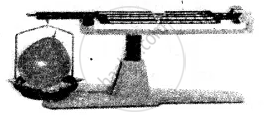
Matter i.e. solids, liquids, and Gases have mass explained by the following experiments.
(1) Solid
Experiment: A solid placed on one side of the scale, causes the scale to tilt towards one side.
Conclusion: The scale tilts due to the mass of the solid, hence all solids have mass.

(2) Liquid:
Experiment: A liquid placed on one side of the scale, causes the scale to tilt towards one side.
Conclusion: The scale tilts due to the mass of the liquid, hence all liquids have mass.

(3) Gas:
Experiment: An inflated balloon placed on one side of the scale causes it to tilt towards one side.
Conclusion: The scale tilts due to the mass of the gas, hence all gases have mass.
APPEARS IN
संबंधित प्रश्न
Fill in the blank:
The change of water vapour into water is called ......................
Give two example of the following:
The substances which sublime.
What do you observe when a gas jar which appears empty is inverted over a gas jar containing Bromine vapours? Name the phenomenon.
There are large intermolecular gaps in
- water
- iron ball
- common salt
- air
If an object is taken to the moon from the earth what will be its mass ?
What happens when a solid is heated ?
Give reason Liquids can flow easily
Write your observation and conclusion for the following,
When a small stone is gently dipped into a glass filled with water.
Give reason
A red ink drop added to small amount of water in a glass turns water red in some time.
Give a reason for the following:
Liquids have one free upper surface only.
